
Sculpture at home: space, light and presence without the gallery effect
A sculpture does not fill a corner: it changes how the room is crossed, observed and remembered.

Some objects decorate; some works ask the home to pause. Sculpture gathers light, draws a shadow, slows a step and makes the empty space around it visible. It can belong without turning the living room into a gallery: what matters is not emphasis but design—appropriate scale, viewing distance, stable support, precise light and an honest dialogue with everything already living in the room.
Emotion comes before the work
Do not choose sculpture because it matches the sofa. Begin with what it provokes: tension, calm, memory, humour or material presence. Photographs and catalogues help, but the work should be seen from several sides and, when possible, in person. A genuine choice survives fashion because it keeps asking questions even when the furniture changes.
Empty space belongs to the composition
Sculpture needs air to be read. Squeezed between lamp, plant and curtain it becomes an accessory; isolated theatrically, it can feel foreign to the home. Draw distances from circulation and the main views from entrance, sofa, table and corridor. Empty space is not wasted space: it is the margin that lets form breathe.
Scale is measured against body and room
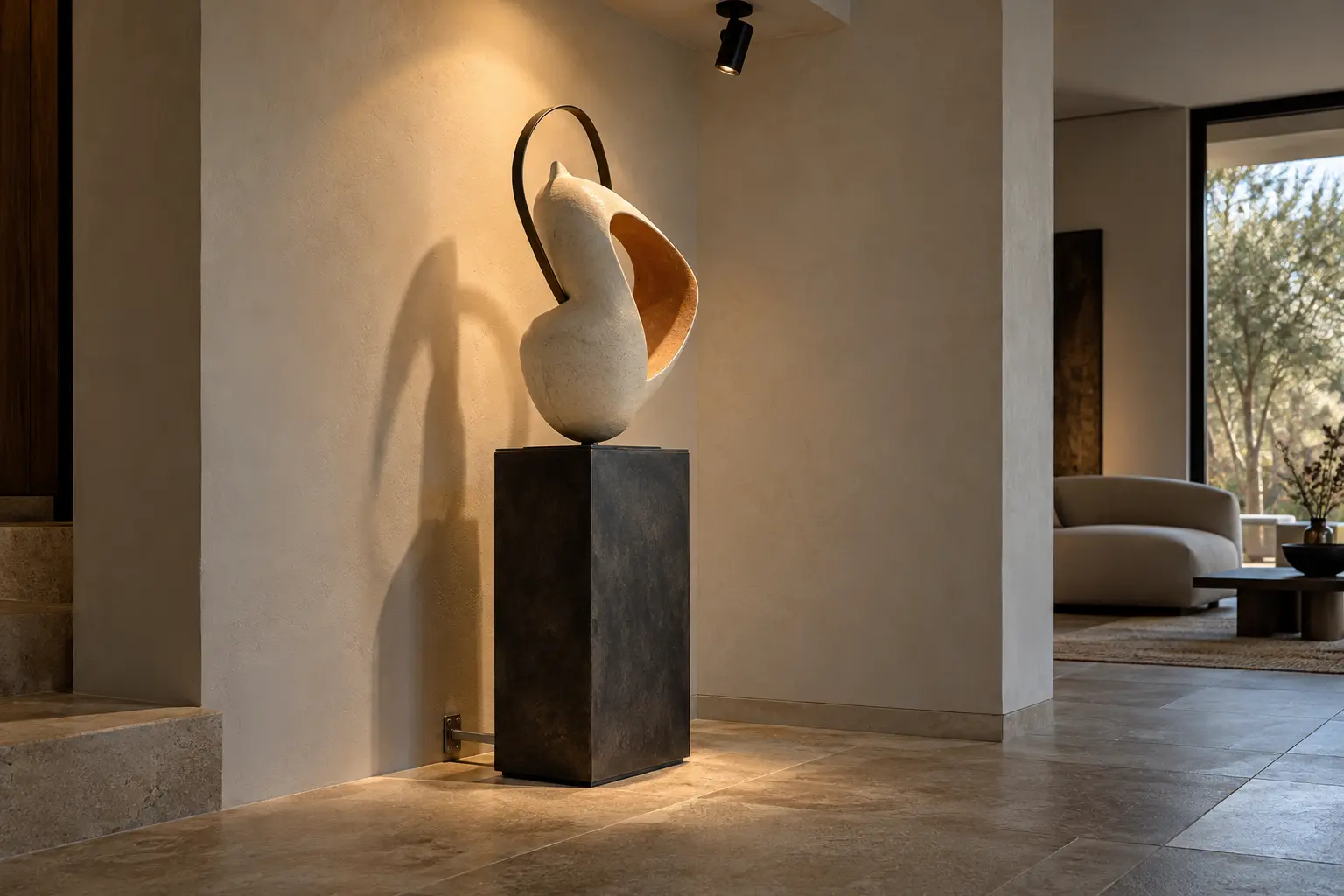
A small work on a shelf asks for closeness; a floor piece must hold attention across several metres. Ceiling height, wall width, seating and doors change perceived proportion. Before buying, make a neutral mock-up at the stated dimensions. What feels powerful in a gallery may disappear at home—or dominate it.
On the floor, on a plinth or in shelving
Floor pieces speak directly to the body but must stay outside daily routes. A plinth raises the viewpoint and declares the work; it should be stable, proportional and quieter than the sculpture. Shelving needs a clear bay, a coherent background and a level readable from a seat. Position follows the work, not an empty piece of furniture.
Light should reveal, not interrogate
An adjustable beam models volume; diffuse light renders material more quietly. Angle, distance and beam spread define shadow and reflection. Avoid glare, excessive heat and visible sources from the sofa. Colour rendering is crucial for timber, stone, ceramic and patina. Test the light at night from the actual viewpoint before fixing it.
Direct sun is not always an ally
Natural light and moving shadows animate form, but UV, heat and rapid change can affect pigments, resins, timber and some stones. Material, finish and the artist’s guidance determine placement. The most dramatic window may be the worst conservation position. Blinds help but do not replace specific advice for valuable or sensitive works.
Stability and safety are part of beauty
Weight, centre of gravity, base, floor and impact risk must be checked, especially with children, pets or narrow routes. Discreet anti-tip restraint can preserve the visual reading. Heavy works require professional handling and a verified support capacity. Resolve safety and insurance before installation, not after the first move.
Material against material, without imitation
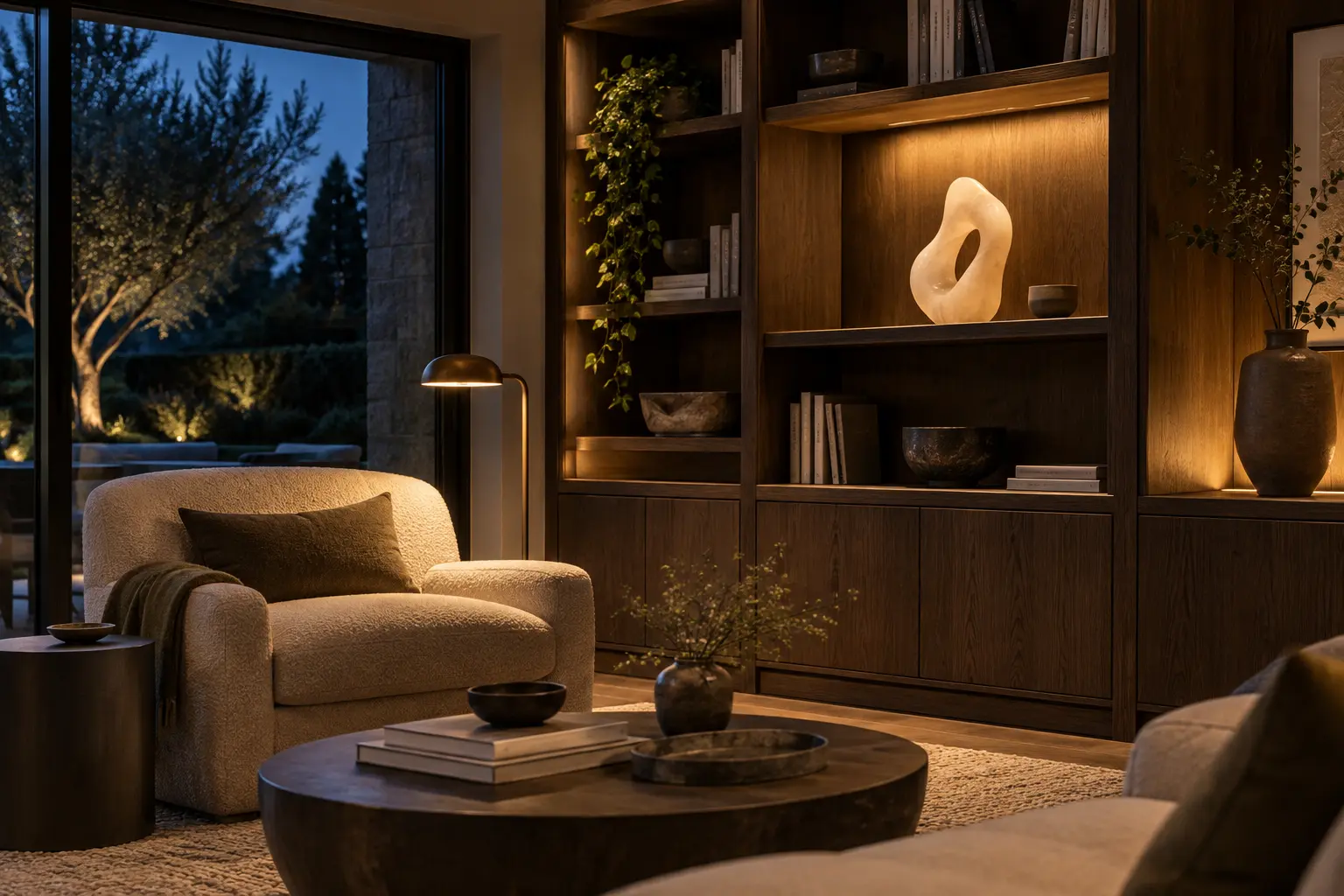
Bronze, ceramic, glass, timber or stone need not repeat the room’s finishes. Controlled contrast is often stronger: a matte form before a mineral wall, dark metal beside warm timber. Reduce competing voices, however. The work may guide the palette without turning every nearby object into a literal echo.
A small collection needs rhythm
More works do not mean more culture. Alternating scale, height and pause creates sequence; aligning everything flattens it. Relationships can grow through material, gesture or memory without perfect symmetry. One protagonist and a few quiet companions often produce more depth than a crowded shelf. Rotation helps familiar works become visible again.
Care begins with knowledge
Dust, touch, domestic cleaners and improvised moves are the common risks. Keep the work’s record, artist, provenance, materials, photographs and care instructions. Never apply wax or detergent without guidance. Check restraint, base and surface changes periodically. Art can join daily life without losing the attention it deserves.
Useful tools and accessories
Book on modern and contemporary sculpture
Helps develop a personal eye before buying, with attention to material, scale and the relationship between art and space.
View on Amazon.itHigh-colour-rendering adjustable spotlight
Can reveal volume and texture when beam, distance, colour temperature and glare are tested in the actual room.
View on Amazon.itMinimal display plinth
Useful for testing the level and proportion of a small work; load, stability and finish must suit its weight and setting.
View on Amazon.itMicrocrystalline wax for compatible surfaces
May suit the care of certain metals or stones, but only when the artist or conservator specifically recommends it.
View on Amazon.itAdvertising · Some links are Amazon affiliate links. Selection remains editorial and independent.
Explore the project
Composing pictures and artworks · Carlo Scarpa: material and detail · Charlotte Perriand: home and freedom · Lighting the living room · Design quote