
Art at home: height, composition and light for a wall with feeling
An art wall does not fill a void: it builds a relationship between space, artworks and the people who see them.
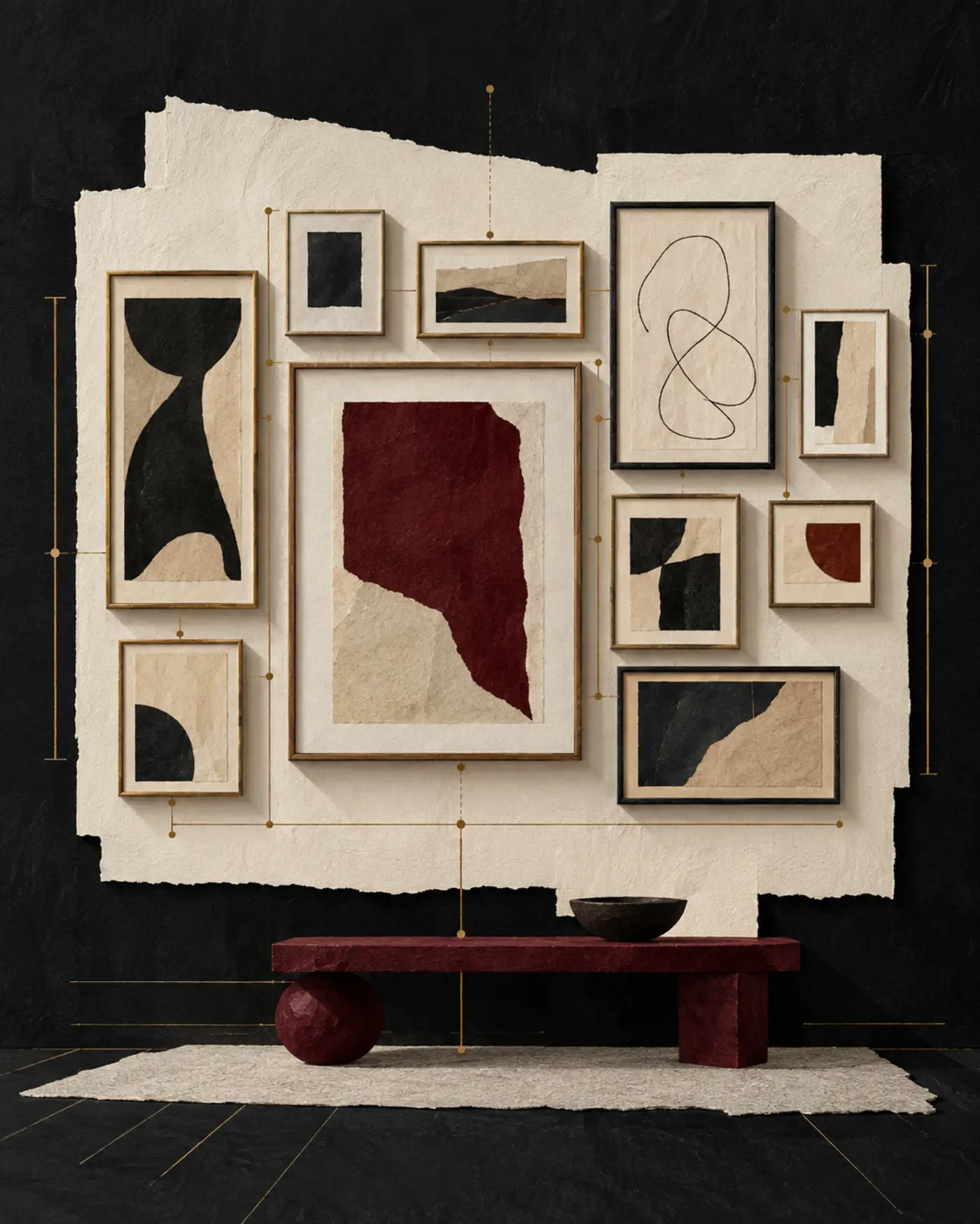
A wall can be full of pictures and still say nothing. This happens when frames are hung one at a time, following impulse without considering the furniture below, the light, viewing distance or the rhythm of the room. Art at home does not need to imitate an institutional gallery, but it does need direction. Family photographs, affordable prints and small handmade works gain authority when they are placed in relation to one another. The point is not to own expensive art; it is to give each piece enough space to be seen and to reveal something about the people who live there.
Before height comes the viewpoint
The familiar rule places the centre of an artwork near eye level, broadly 145–155 centimetres from the floor. Treat this as a reference, not a law. A corridor is viewed while walking, a living room often while seated, and a stair composition rises with the steps. Begin where the work will most often be seen and test the position with paper cut to the same dimensions.
Above a sofa, sideboard or headboard, art should belong to the furniture without crushing it. A broad 15–25 centimetre gap often creates continuity, adjusted for frame, backrest and wall size. Too high and the work floats; too low and furniture and image become a heavy block.
Proportion: art converses with what sits below
A single work above furniture often feels balanced at roughly one half to two thirds of its visual width. This is not a mechanical percentage: dark imagery carries more weight than a pale print, a thick frame increases presence and a generous mount introduces air. Judge the total mass, not centimetres alone.
Do not force a small picture into the centre of a vast wall. It may live better beside a lamp, on a picture ledge or within a group. A large work needs lateral space and enough distance to step back. Photograph mock-ups from several viewpoints before drilling; a screen reveals tilts and imbalances the working eye tends to forgive.
Gallery walls: design the space between frames
A composed wall is not a random collection. Choose an organising principle: a centre line, shared top edge, grid or dense core expanding asymmetrically. Keep spacing consistent—often 5–8 centimetres for a compact group, wider for large formats and walls. Rhythm can create unity even when colours and frames differ.
Lay the arrangement on the floor, then tape paper templates to the wall. Begin with the dominant element and balance weight, orientation and colour around it. Avoid distributing everything evenly: larger pockets of emptiness provide breath and clarify hierarchy. An elegant gallery wall has a lead voice and intentional pauses.
Frames and mounts: protection before decoration
A frame mediates between artwork and room; it need not copy every metal or timber finish. Natural woods warm drawings and photographs, black profiles define and pale finishes lighten. Repeating two or three finish families avoids showroom uniformity without creating confusion. A mount visually separates the image and can reconcile varied formats.
For original works, photographs and sensitive papers consider UV-protective glazing, acid-free materials and reversible mounting by a professional framer. Avoid direct sun, damp and condensation-prone walls. Conservation comes before styling: a faded or buckled work loses the emotion you wanted to reveal.
Three tools for a controlled installation
Fixing depends on artwork weight, wall construction, frame and surface condition. The selected products answer three different needs: removable mounting for compatible light frames, a mechanical fixing to be checked against the substrate and a level for alignment. Always read load ratings and instructions for the exact variant; use a qualified installer for heavy works, hollow walls or uncertainty.
The White Diamond selection
A personal wall begins with what you want to look at. The geometric decoration and frame offer two different visual languages; installation tools support the arrangement without defining it. Consider one main focal point, leave space around it and choose fixings only after identifying the wall and load.
Advertisement · Product links are Amazon affiliate links. As an Amazon Associate I earn from qualifying purchases. Prices and availability may change.
Umbra Prisma Wall Décor
On a wall that needs depth, a three-dimensional geometric composition can be more interesting than another flat picture. Prisma Wall Décor is a decorative object, not an original artwork: use it to break a sequence of frames or create an accent on an otherwise clear wall. Side lighting reveals its volumes and shadows. Leave space around the composition and check the fixings and set contents in the listing.
Explore the product on Amazon.it ↗Umbra Prisma · cornice 20 × 25 cm, nera
The geometric frame gives a personal photograph or small print more presence: the content remains yours while the border becomes part of the composition. It suits a console or shelf where a large format would dominate. Choose a visually simple image and echo the black in just one other detail. Check the usable picture size and display method; the frame does not automatically include your chosen print.
Explore the product on Amazon.it ↗Command 17204WHI-4-ISP · medium picture-hanging strips
Four pairs intended for compatible light frames and suitable interior surfaces, useful when avoiding holes and retaining the option to adjust. They are practical for lighter, evolving arrangements, but not universal: confirm load, wall finish and 3M application and removal procedures. Do not use on delicate surfaces or valuable works without specific assessment.
View on Amazon.itfischer DuoPower 6/3 · plug with closed eye
A bi-material mechanical fixing with an eyelet, documented by fischer for different substrates. It can provide a stable hanging point when diameter, screw, load and wall are compatible. Identify whether the wall is solid, perforated or plasterboard and verify the exact variant before buying: performance depends on correct installation, not on the plug alone.
View on Amazon.itSTABILA Type 70 · aluminium spirit level
A light conventional level with readable vials and a coated measuring surface, useful for checking frames without trusting perception alone. A compact length supports repeated checks across a gallery wall. It confirms horizontal alignment but does not design the composition; an asymmetric arrangement can be correct because it follows rhythm rather than a rigid grid.
View on Amazon.itAdvertisement · As an Amazon Associate I earn from qualifying purchases. Check the variant, dimensions and terms in the seller’s listing.
Light should reveal, not attack
Side daylight reveals texture, but direct sun can damage pigments and paper. At night use adjustable, gentle light without frontal glare. A narrow beam creates a theatrical circle; a very wide beam flattens both wall and artwork. The aim is to make the image legible without turning it into a shop display.
Keep colour temperature consistent with the room and judge works under the light actually used. A source with good colour rendering helps preserve subtle differences. Position spotlights and wall washers so the viewer casts no shadow and glazing does not mirror the light source.
Mistakes that make a wall feel temporary
Hanging too high, matching every frame without reason, aligning to the ceiling rather than furniture, ignoring switches, choosing unsuitable fixings and filling every gap with small pieces are common errors. Mixing original art and reproductions is not a problem when the selection is personal and the logic is clear.
Before final installation, record dimensions, weight, substrate, centre height, spacing and lighting. Keep photographs and fixing positions. Precision does not cool emotion; it allows emotion to surface without noise. A well-composed wall does not demand attention—it holds it.
Sources and further reading
The home becomes a visual biography
Selecting and placing art means deciding which images will accompany everyday life. White Diamond can study walls, light and proportions through plans and visualisations, turning a varied collection into an intimate, elegant and coherent story.
Let’s design your art wall