
Curved walls and contemporary arches: softening space without creating a set
A well-drawn curve does not decorate a room: it slows the pace, carries light and makes transitions feel natural.
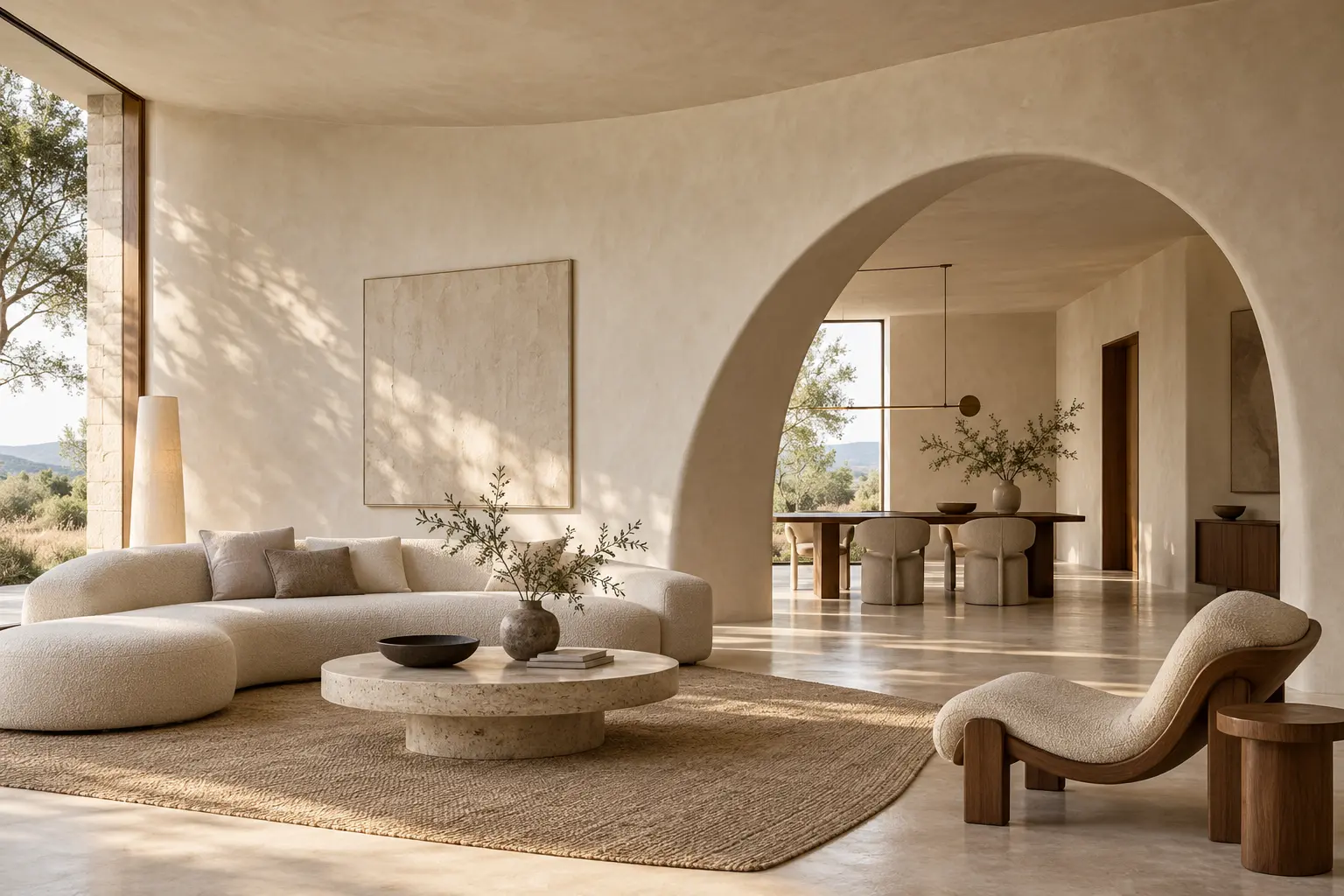
You sense it before you see it. A corridor stops feeling like a tube, light glides instead of breaking, and the body discovers a gentler route. Curved walls and contemporary arches can genuinely change how a home is inhabited, but only when they grow from plan, structure and daily gestures. Added as frames, they become scenery; when thickness, radius and material are coordinated, they feel as though they have always belonged.
A curve must resolve movement
Start with the route, not the shape. A rounded wall can guide the entrance towards the living room, visually widen a hall or protect a busy corner. Draw paths with doors and furniture in place, noting what is revealed as one moves. If the curve forces pointless detours or steals valuable area, it is not working; it is demanding attention. The best geometry is recognised by how naturally it guides the body.
Radius and proportion set the character
A tight radius feels energetic and demands precision; a broad one reads almost as a straight wall slowly changing direction. There is no universal dimension: passage width, ceiling height, wall thickness and distance from doors and windows all matter. Draw it in plan and test it full-size with tape or a template. A few centimetres can alter both perception and the feasibility of profiles, boards and finishes.
A contemporary arch begins in section
Round, segmental, elliptical or asymmetric: the label matters less than the relationship between opening, springing line and reveal depth. An elegant arch is not a semicircle applied above a rectangular door; it is a three-dimensional passage. The reveal may become a continuous surface that catches light or a precise cut. Before opening a wall, a qualified professional checks structure, services and permissions: form cannot ignore what supports the home.
Dry lining, masonry or joinery
Dry construction is light and controllable, but regular curves require close framing, suitable boards, correct joints and skilled finishing. Masonry offers mass and solidity with different weight and timing. Joinery can make curved storage walls, niches and panelling but must manage modules, grain and maintenance. The choice is not merely aesthetic: radius, impact, acoustics, planned fixings and access to services all influence it.
Floor and skirting cannot be an afterthought
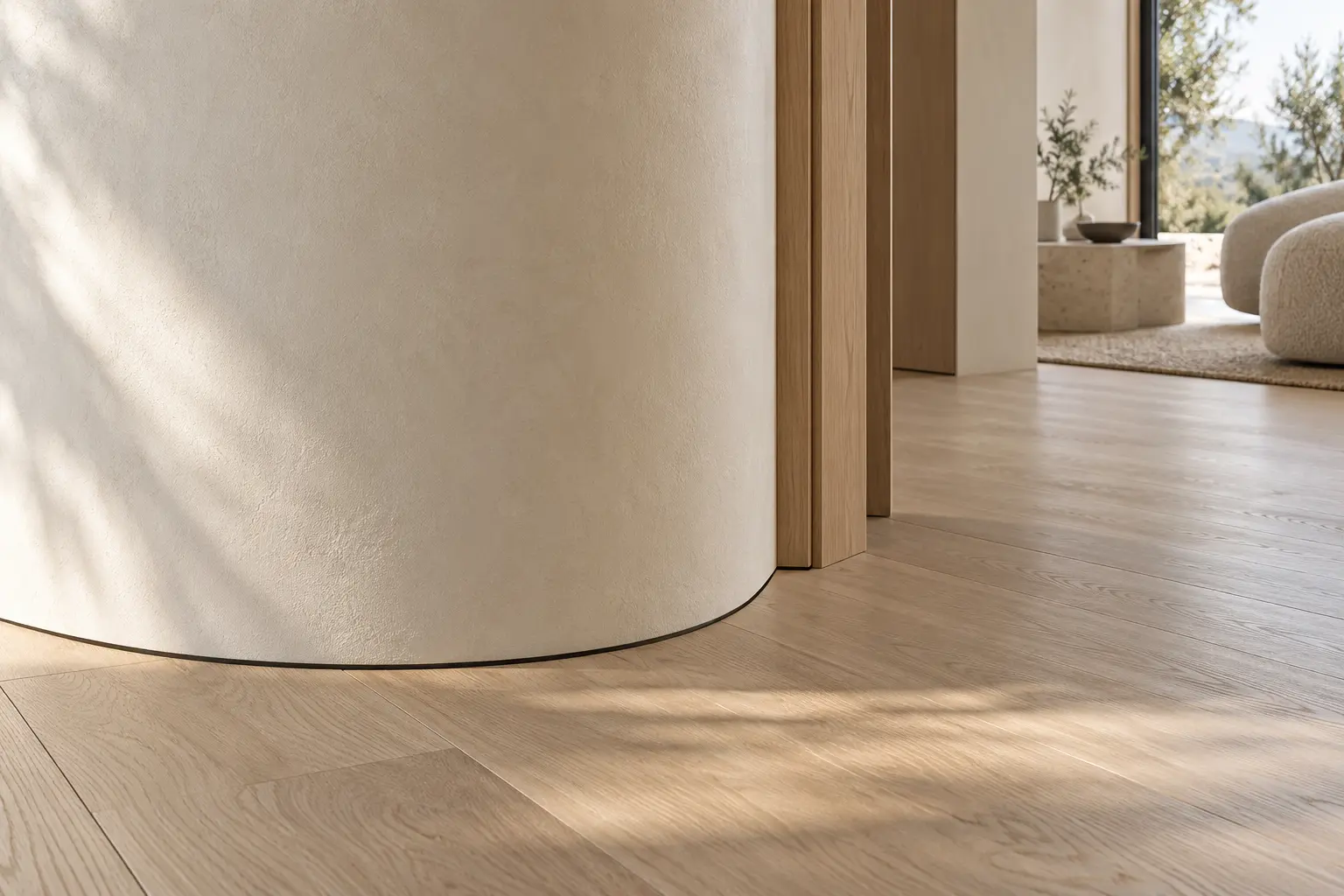
A curve meets the floor along a line that exposes every approximation. Flexible skirting, a shadow gap or a bespoke plinth must respect radius and tolerances; rigid segmented pieces can create a broken edge. Timber boards or large-format tiles also need a laying direction related to movement. Draw the junction before site work and allow technical joints where necessary. Convincing continuity is decided close to eye level.
Doors, reveals and services need discipline
Switches, sockets, thermostats and doors should not look stranded by the curve. Devices need sufficiently flat zones and reachable heights; a flush door may require a straight jamb for frame and seals. If the opening itself curves, hardware and joinery become specialist items. Concentrate services in accessible areas and record their routes. A fluid gesture remains elegant when essential functions are not concealed irreversibly.
Grazing light is beautiful and unforgiving
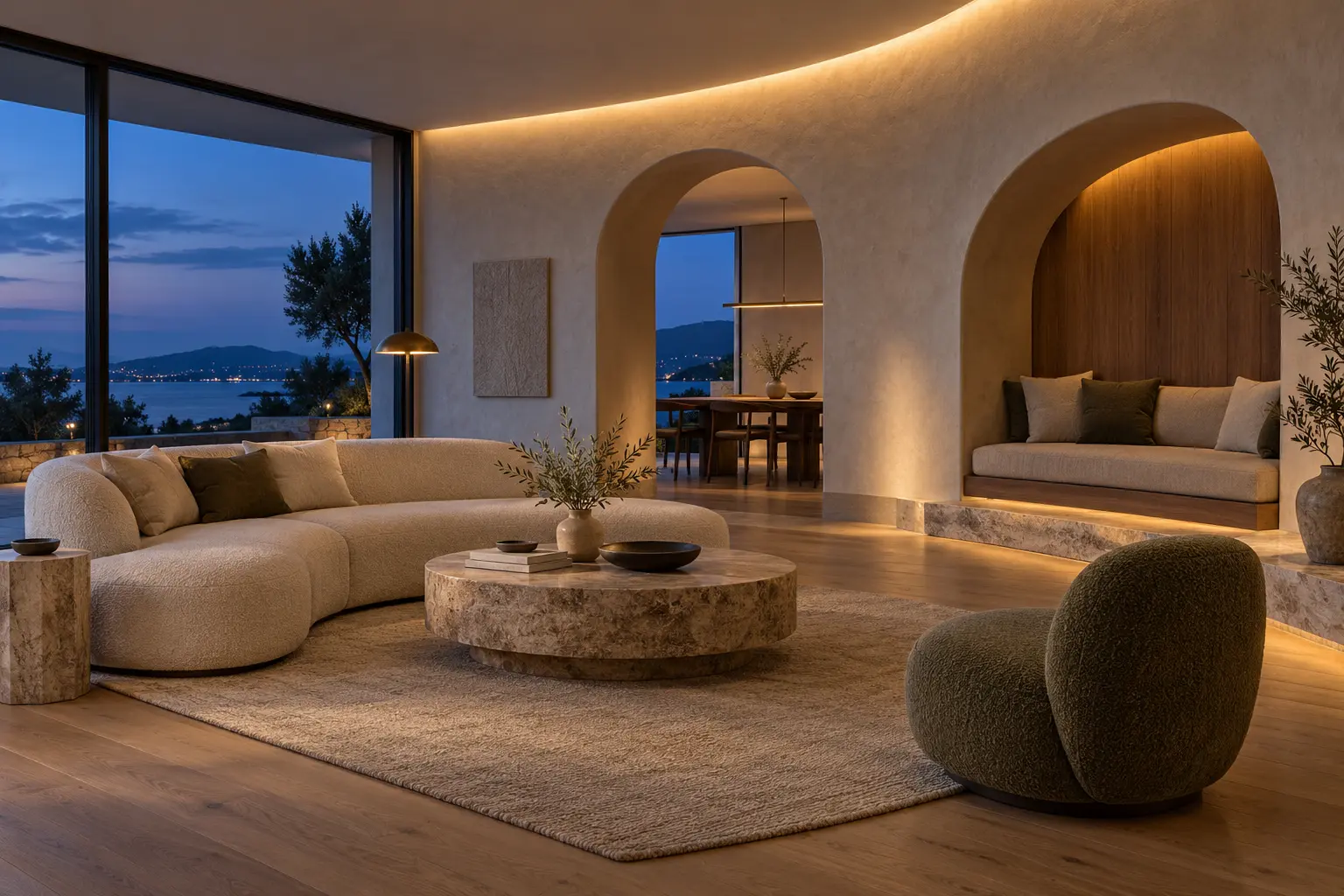
Light moving across a curved surface increases depth but also reveals waves, poor skim coats and joints. Define the source, distance, optic and finish, then build a sample. An indirect profile must dissipate heat and remain inspectable; its driver cannot vanish inside a sealed wall. By day, a side window may achieve more than many spotlights. A curve needs graduated light, not a compulsory luminous outline.
Furniture should follow only when useful
Covering every curved wall with bespoke curved furniture can make a room contrived and expensive. Sometimes the contrast of a straight bench or a freestanding round table gives more air. Fitted elements work when they recover storage or create seating, but they still need installation, adjustment and repair access. Check doors, drawers, robot vacuums and support points. The house stays adaptable when geometry does not trap every future change.
Acoustics, impact and maintenance
A curved wall scatters sound differently from a flat one, but it does not replace acoustic design. In reverberant rooms, coordinate textiles, absorptive panels and furniture without weakening the concept. Busy passages need resilient finishes and edges that tolerate bags, prams or cases. Paints and plasters should be repairable, illuminated niches cleanable. Sensual form lasts when the years after the photograph are part of the brief.
One leading curve, everything else quiet
The greatest risk is adding arches, niches, waving ceilings and organic furniture until every element asks to be seen. Set a hierarchy: one wall guides movement, one arch opens the view, and other details support them. Continuous materials, few colours and precise junctions let shadow speak. In renovation, correcting one corner or reshaping a threshold may be enough. Success is not the number of curves, but the naturalness they return to space.
Useful tools and accessories
Book on curves and organic interior forms
A visual reference for understanding proportion, radii and spatial continuity without treating the curve as a trend.
View on Amazon.itCross-line laser level
Useful for transferring axes, springing levels and alignments; surveying and installation remain professional work.
View on Amazon.itFlexible LED profile
Can follow a curved geometry when minimum radius, heat dissipation, access and light source are properly checked.
View on Amazon.itMineral plaster sample
Lets grain and grazing-light behaviour be assessed on a real surface before the finish is extended.
View on Amazon.itAdvertising · Some links are Amazon affiliate links. Selection remains editorial and independent.
Explore the project
Contemporary doors and passages · Indirect light at home · Lime paint and light · Bespoke furniture without mistakes · Design quote