
Designer planters and indoor plants: compose greenery without the nursery look
Plants bring life; planters set the rhythm. The most refined result appears when botany, light and proportion speak the same language.
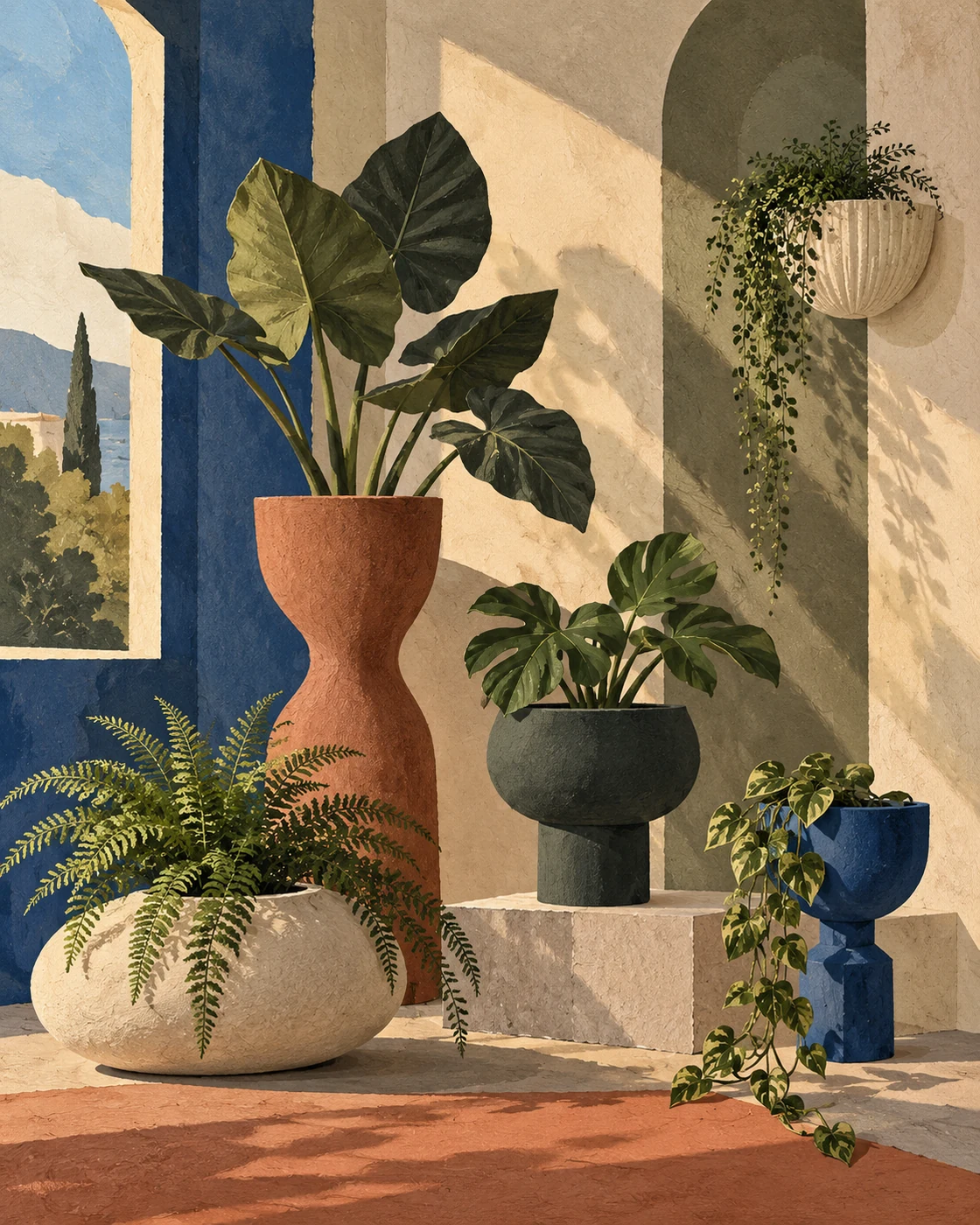
You chose beautiful plants one at a time, yet together they look temporary: five unrelated containers, visible saucers, similar heights and overlapping leaves. The problem is not too much greenery. It is greenery without hierarchy. An elegant plant corner is not created by buying many matching pots; it appears when each plant receives suitable light and root volume while the group follows a legible rhythm. A planter is therefore not a neutral frame. It determines level, colour, material and distance from the floor. Before looking for the most attractive model, design the relationship between living organism, container and room.
Begin with the plant, not the planter colour
Study the species, root system, growth habit and expected size. Trailing foliage needs a free edge; broad leaves need lateral room and a viewpoint that does not crush them against a wall. A tall specimen is not automatically the focal point: if the container raises it too far, it may clash with windows, curtains or circulation. Check cultivation guidance and measure both the nursery pot and the foliage.
Do not repot merely because a decorative container is large enough. Drainage, reservoir and material must suit the species and your routine. A cachepot may conceal the technical container, but you must still be able to inspect standing water. Self-watering systems can simplify some tasks; they do not remove the need to observe the plant or make different species identical.
Compose three levels rather than one row
A readable sequence alternates low, medium and high levels. Create them through the plants, the vessels or one stable pedestal, rather than exaggerating all three at the same point. Mark the available floor area and test real dimensions with cardboard cylinders or boxes. Leave enough space to rotate containers, clean the floor and reach the window.
Avoid a row of equal-height pots against the wall: it flattens volume and makes every colour difference feel untidy. Build a visual triangle and preserve one area of emptiness. Empty space is not wasted; it lets leaves cast shadows, makes silhouettes legible and permits maintenance. In a small living room, two calibrated presences may feel more generous than six tiny specimens.
A short palette lets leaves speak
Choose no more than two finish families for the main containers. Matte ceramic with slender metal, or recycled plastic with one accent colour, is clearer than five competing textures. Echo a colour already present—the blue of a chair, terracotta in an artwork or black window frames. It need not match exactly; a related undertone is enough.
Glossy surfaces reflect light and attract attention, while matte ones soften volume. A sculptural vessel can become the focal point without a large plant, but it should not compete with another statement object nearby. Always distinguish material from finish: stone effect is not stone, and a metallic colour is not solid metal. This precision prevents false expectations about weight, care and longevity.
Light and maintenance belong to the aesthetic
A compact group should not force every plant into the same exposure. Observe the room at different times: the bright zone may shift, and direct sun through glass can be intense. If two species need incompatible conditions, separate them even if they look good in the same photograph. A credible composition must still look well after months, not only on installation day.
Plan watering without dragging water across the floor. Protect timber and sensitive stone, check total weight and choose stable supports. Wall and hanging vessels require fixings suited to the actual surface and wet load, not merely empty weight. Allow for pruning, leaf cleaning and access to saucers: invisible maintenance preserves the elegance.
A practical example: a 140-centimetre niche
Imagine a 140 cm clear wall beside a window, with circulation to the right. Place a tall narrow vessel on the left, a lower container with fine foliage slightly forward in the centre and a small wall vessel with controlled trailing foliage on the upper right. The composition rises away from the route and keeps the useful floor clear.
Graphite and chalk might form the base palette, with one blue accent. Before buying, mock up diameters and heights, then photograph the test from the entrance and sofa. If the most decorative planter steals attention from the plant, reduce the number of colours. If leaves merge into an indistinct mass, increase the spacing. The best budget is not evenly spread: invest in the focal piece and keep service containers restrained.
Mistakes that turn greenery into noise
Buying the set before the plants is the first error: commercial composition then dictates dimensions and drainage. The second is using many small pots to fill a large wall; the eye reads fragments and maintenance multiplies. The third is hiding cables, sockets or curtains behind foliage that must be moved daily. The fourth is trusting a shelf without checking its load and fixings.
Review the group after a week of real use. Can you open the window, vacuum and water without dismantling everything? Remove one element before adding another. Here, luxury is not abundance; it is the sense that every volume has a reason, every leaf has room and every gesture was anticipated.
Objects selected for the project
Five alternatives with distinct roles: one ceramic focal point, two practical floor or console containers and two vertical solutions. They are not a set to buy together. Choose the model that solves your relationship between plant, light and space; Amazon.it links open the exact-model search, so check seller and variant.
Iittala Nappula, 260 × 155 mm high planter
Matti Klenell’s stemmed silhouette raises the plant and makes the container a sculptural object. The ceramic body is 26 cm high and 15.5 cm wide, suited to a deep console or stable plinth. Pair it with compact foliage so the outline stays visible. Its relatively narrow base is the limitation: check stability, weight and inner-pot compatibility. Treat it as an alternative focal piece, not as another addition to an already crowded group.
Find the model on Amazon.itLECHUZA CLASSICO Color 28
The quiet round profile gives priority to foliage. The maker lists approximately 27.5 cm diameter, 26 cm height and a reservoir irrigation system—useful when you need a visually orderly container and measurable routine. Its lightweight finish can help considered repositioning, but it is not stone or ceramic. Check initial setup, indicator, root volume and the species’ requirements; a reservoir is not permission to water without observation.
Find the model on Amazon.itelho Vibes Fold Round 22 cm
The ribbed surface adds texture without an aggressive colour statement. At roughly 22 × 20 cm, it suits a strong shelf, low cabinet or medium-scale grouping. The maker describes it as recycled plastic and watertight, which protects the supporting surface but does not replace checking drainage and standing water in the nursery pot. It is an accessible alternative when two coherent containers are more useful than making every pot a focal object.
Find the model on Amazon.itUmbra Trigg, set of two wall vessels
Two geometric containers move greenery onto the wall and release the surface below. Each measures about 12 × 6 × 19 cm in the consulted specification: it is intended for small plants or light decorative use, not a substantial root system. The metal frame adds a graphic line beside a desk or within a niche. Check variant material, drainage, fixings and load; damp or friable walls call for a different solution.
Find the model on Amazon.itUmbra Triflora, set of three hanging planters
The horizontal rail and adjustable ropes turn a window into a vertical composition. The planters accommodate small nursery pots of about 7.6 cm; the practical benefit is varying height and spacing without occupying the sill. Use it where light is appropriate and the window can still open. Watering, drips and wet weight are its practical limits. Check overall dimensions, anchoring and support compatibility before installation.
Find the model on Amazon.itAdvertisement · Product links are Amazon affiliate links. As an Amazon Associate I earn from qualifying purchases. Prices and availability may change.
Sources and further reading
Official specifications and Amazon.it links consulted on 3 October 2026. The Amazon link opens a search for the model: check seller, variant, dimensions and availability before buying.
Let greenery become part of the architecture
White Diamond can study your room’s light, circulation and proportions, developing a plant composition consistent with furniture, materials and real maintenance. A personalised design and renders let you compare levels, colours and footprints before buying containers. Tell us which wall or corner you want to transform, and we will give greenery room to live and the home a more personal rhythm.
Request your personalised quote