
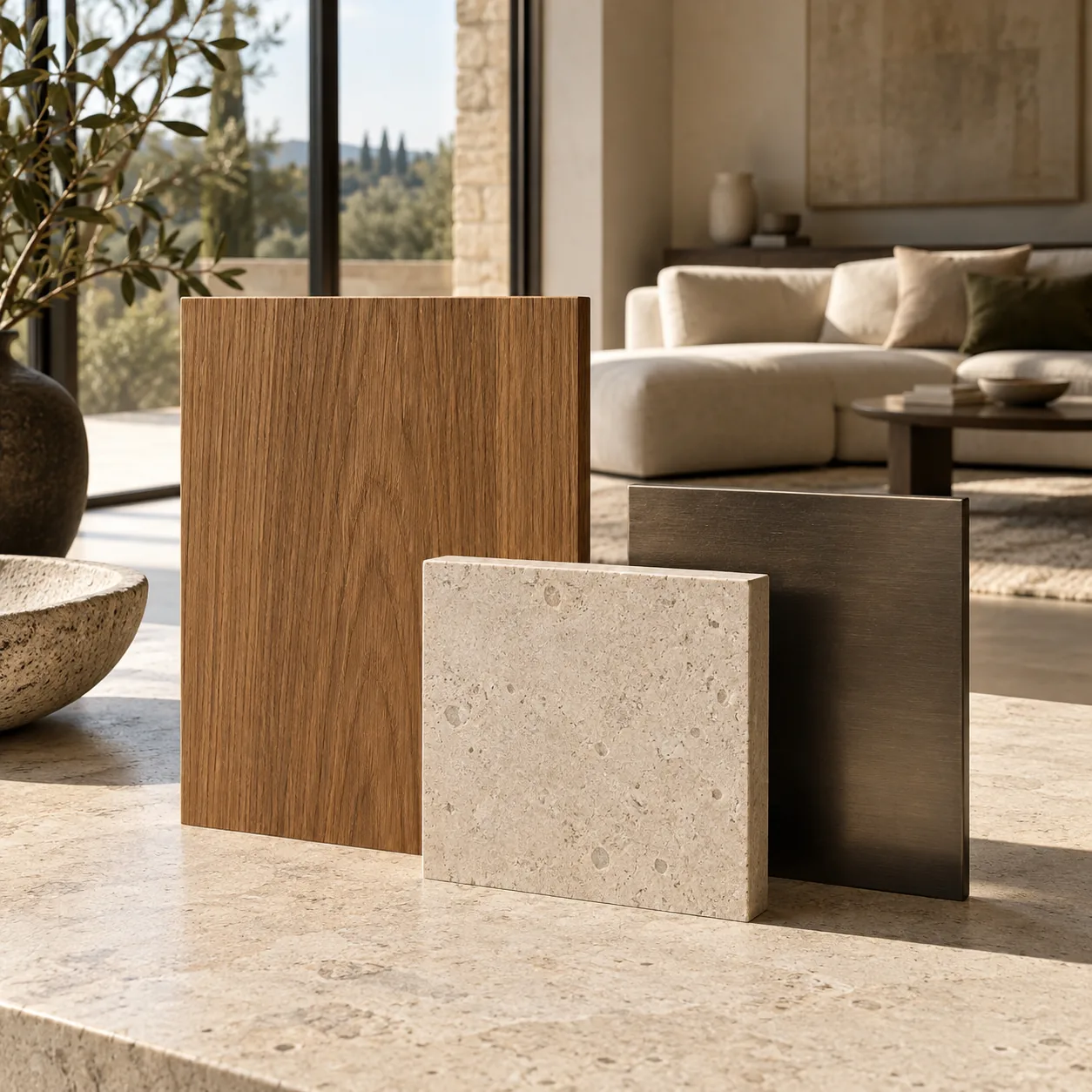
Wood, stone and metal in balance.
A floor, a table and a kitchen may each look beautiful on their own but feel unsettled together. Materials need roles and a shared visual temperature.
A floor, a table and a kitchen may each look beautiful on their own but feel unsettled together. Materials need roles and a shared visual temperature.
Give each material a role
Let one finish lead across large surfaces, another support it and a third mark details. A repeated metal accent can create continuity without making everything match.
Look at undertones
Two pale woods can differ sharply in real light. Bring samples into the room and compare them against the floor during the hours you use the space.
Balance matte and reflective finishes
Too many reflective surfaces can feel tiring. Contrast tactile, quiet textures with a few brighter details. Metal can define a railing or piece of furniture without dominating the room.
Make a physical palette
Photograph three real samples together in daylight and again with the evening lights on. Removing one competing finish may be the strongest design choice.
Products to consider for this space.
Compare these specific models against your room, measurements and routine.
Umbra Bellwood coffee table
Introduce wood with a soft-lined table. Compare its undertone with the existing floor.
Find this model on Amazon ↗Yamazaki Tower steel tray
Repeat a metal detail while giving small objects an orderly place. Let function guide the finish.
Find this model on Amazon ↗Navaris marble tray
Try a mineral surface on a small scale before committing to larger finishes. Compare the real material in daylight.
Find this model on Amazon ↗Advertisement · These are Amazon affiliate links.
Let's find a solution that feels like yours.
Tell me about the room, your questions and what you would like to change.
Discuss your project