
Herbs in the kitchen: designing a small garden well
The scent of a leaf brushed by hand can change an ordinary gesture. For herbs to remain beautiful and useful, however, their place needs the same care as a lamp or worktop.
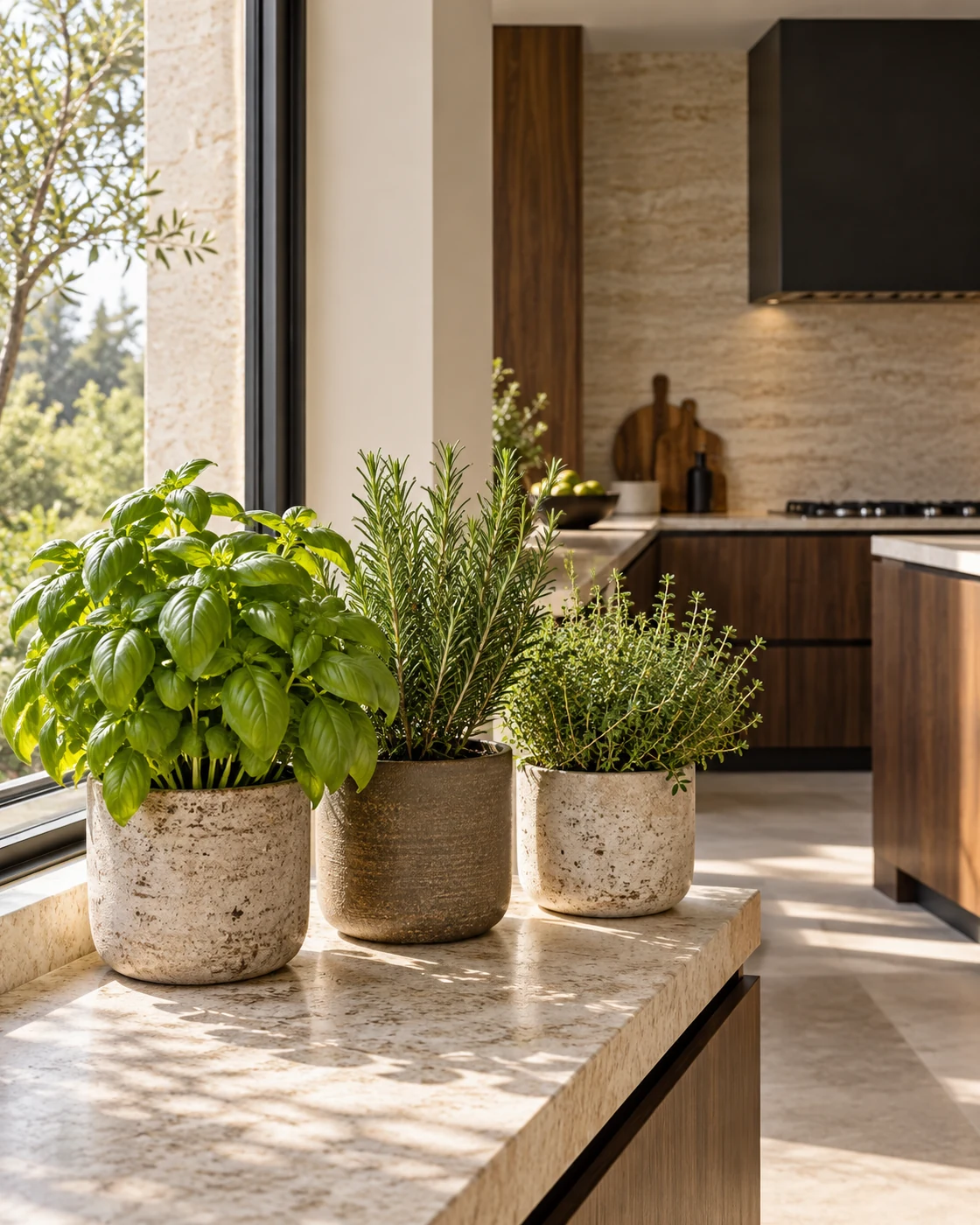
You buy a pot of basil, set it beside the sink and for a few days the kitchen feels more alive. Then the leaves droop, the compost stays wet or sunlight scorches them through the glass. This is not necessarily a lack of gardening skill: often, what is missing is a small design. Herbs are living organisms, but they also occupy a working space. They need light, air, water and easy access without obstructing food preparation. When these needs converse with the room’s materials and proportions, greenery stops looking accidental and becomes part of everyday architecture.
Begin with light, not the pot
Observe the kitchen for a full day before deciding where the herbs should live. A bright window is often useful, but orientation matters: strong sun through glass may overheat leaves and containers, while a corner far from the window may be inadequate even when it looks bright. Basil, rosemary and thyme do not respond in exactly the same way; follow the guidance supplied with each plant and change exposure gradually.
Do not automatically use the narrowest windowsill. Check the opening path, draughts, radiators and distance from the hob. Steam, heat and grease make maintenance harder and may soil leaves. A side shelf, bright niche or free section of worktop can work better when it remains easy to reach and does not interrupt the wash–prepare–cook sequence.
Create a composition, not a random row
Three matching pots create order, but they are not the only answer. Repeat one material while varying height slightly, or use a single tray to contain different vessels. Leave visual breathing room: if the group occupies every available centimetre, it will read as clutter. In a small kitchen, two or three herbs you genuinely use are often more elegant than a complete indoor garden.
Dark timber and pale stone work well with matt black, ivory or natural terracotta pots. On a heavily veined surface, reduce patterns and contrast; on a plain worktop, a tactile finish can add depth. Do not coordinate every object rigidly. Greenery brings an organic variation. Echo one existing detail, such as the tap or handles, and let leaves and scent take the lead.
Water and drainage: the invisible design
An outer pot must not conceal what is happening around the roots. Check drainage or the real operation of the chosen watering system. A cachepot may hold water at the bottom; a reservoir system still requires its manufacturer’s instructions and the needs of the species. Feeling the growing medium and observing the plant is more useful than applying one automatic schedule to every herb.
Protect the worktop with a stable saucer or tray, especially on timber, sensitive stone or delicate joints. Dry spills and clean the container regularly. Grouping pots simplifies care but does not mean watering them equally. Rosemary and thyme often prefer different conditions from basil. The arrangement should let you lift, inspect and rotate each pot without dismantling everything.
Fit herbs into the work of the kitchen
The ideal distance is measured in gestures as much as centimetres. Frequently used herbs should be reachable without crossing the hot zone or moving appliances. Keep dedicated snips and a small waste bowl nearby; return them after use. The composition stays attractive because it is easy to use, not because it is treated as a display.
Where the worktop is limited, consider a rail or vertical support only after checking fixing points and load. A suspended solution frees surface space but may make watering and cleaning awkward. Measure mature plant height, pot depth and door clearances. Truly functional furniture does not merely add objects: it reduces friction and makes movement feel natural.
When daylight is not enough
In an internal or poorly oriented kitchen, a small assisted garden may be more honest than pots destined to weaken. An integrated grow light occupies space and introduces a visible technical object. Treat it as an appliance, with a socket, cable, height and reflections. Do not hide it in a dark corner for discretion if that makes it difficult to use.
Place it where the light will not disturb dining in the evening and where the tank remains accessible. Check current consumption, refills and compatible pods on the manufacturer’s listing. Technology is valuable when it solves a real limitation of the room; it does not replace observing plants or make every species automatically suitable.
Mistakes that turn greenery into clutter
The first mistake is buying many plants without deciding who will care for them and how often they will be used. The second is choosing containers by colour alone while ignoring diameter, drainage and growth. Decorative labels can become visual noise too. If you know the herbs, coherent forms are enough; when labels are needed, choose small washable markers.
Avoid shelves that are too high, unstable pots and watering routes above sockets or appliances. Do not place edible leaves where cleaning sprays regularly reach them. Before buying, test the layout with paper outlines: see how much worktop remains and whether the window, cupboard and dishwasher can open. A one-minute simulation avoids a solution that is attractive in a photograph but awkward every day.
A practical example for a medium-sized kitchen
Imagine a travertine worktop beside a window, with sixty centimetres free from the preparation area. A low tray holds basil, rosemary and thyme; the tallest pot sits behind and the compact one in front. The snips stay in a nearby drawer. Side light animates the leaves in the morning; at night, a small under-cabinet light serves the worktop without turning the plants into scenery.
The budget can remain modest with simple pots and saucers if the position is right. If watering is often forgotten, a reservoir pot may help; if light is lacking, an indoor garden may be more appropriate. There is no need to buy everything together. Start with one herb you genuinely use, observe it for several weeks and build the rest around that experience.
The White Diamond selection
Greenery must work as cultivation before it works as a composition. The two LECHUZA planters are alternatives to compare for size and appearance; the garden with integrated light answers a different need. Choose according to available light and care habits: the real benefit is using and enjoying plants you can maintain.
Products to considerThree tools for different needs: they do not form a kit and are not all essential to the same scheme. Official product pages and Amazon Italy searches were checked on 30 September 2026; confirm variant, box contents and availability before ordering.
LECHUZA CUBE Color 14
A compact planter designed to hold small herb nursery pots, using the wick system described by the manufacturer. It is worth considering when you want a composed appearance without a visible saucer. Check nursery-pot diameter, setup instructions and the plant’s needs: a reservoir does not mean every herb should receive identical watering.
View on Amazon.itClick & Grow Smart Garden 3
A three-pod indoor garden with integrated light, useful to consider where the kitchen lacks adequate daylight. The manufacturer lists three basil pods in the starter configuration. Measure the worktop, available height and socket distance before ordering; also consider refills, compatible pods and how visibly the light will sit in the room.
View on Amazon.itFiskars Solid Herb Snip SP220
Compact snips intended for precise cutting of herbs, flowers and small stems. They support a clean, controlled harvest instead of tearing leaves. Store them dry near the herb area but away from soiled utensils, and follow the manufacturer’s guidance for use and care.
View on Amazon.itAdvertisement · Product links are Amazon affiliate links. As an Amazon Associate I earn from qualifying purchases. Prices and availability may change.
Official product pages checked on 30 September 2026.
LECHUZA CUBE Glossy 16 · bianco, 13520
A clearly shaped planter makes greenery stand out without cluttering the kitchen counter. Consider CUBE Glossy 16 for one herb plant: its compact silhouette helps create an orderly composition near a window. The practical benefit is fresh leaves within reach when light and growing conditions are suitable. The plant is not included unless stated otherwise; check the nursery-pot size and watering-system instructions before pairing them.
Explore the product on Amazon.it ↗Advertisement · As an Amazon Associate I earn from qualifying purchases. Check the variant, dimensions and terms in the seller’s listing.
A small garden that is truly lived with.
Herbs bring something to the kitchen that no finish can imitate: living, scented, changing material. Quality comes from balancing plant care with spatial order. If you would like to integrate greenery, light and function into your kitchen design, we can develop a solution around your habits.
Tell me about your kitchen