
Dining chairs: comfort begins before you sit down
A chair can be beautiful on its own and wrong around your table. Good design measures bodies, gestures and clearances before choosing a silhouette.
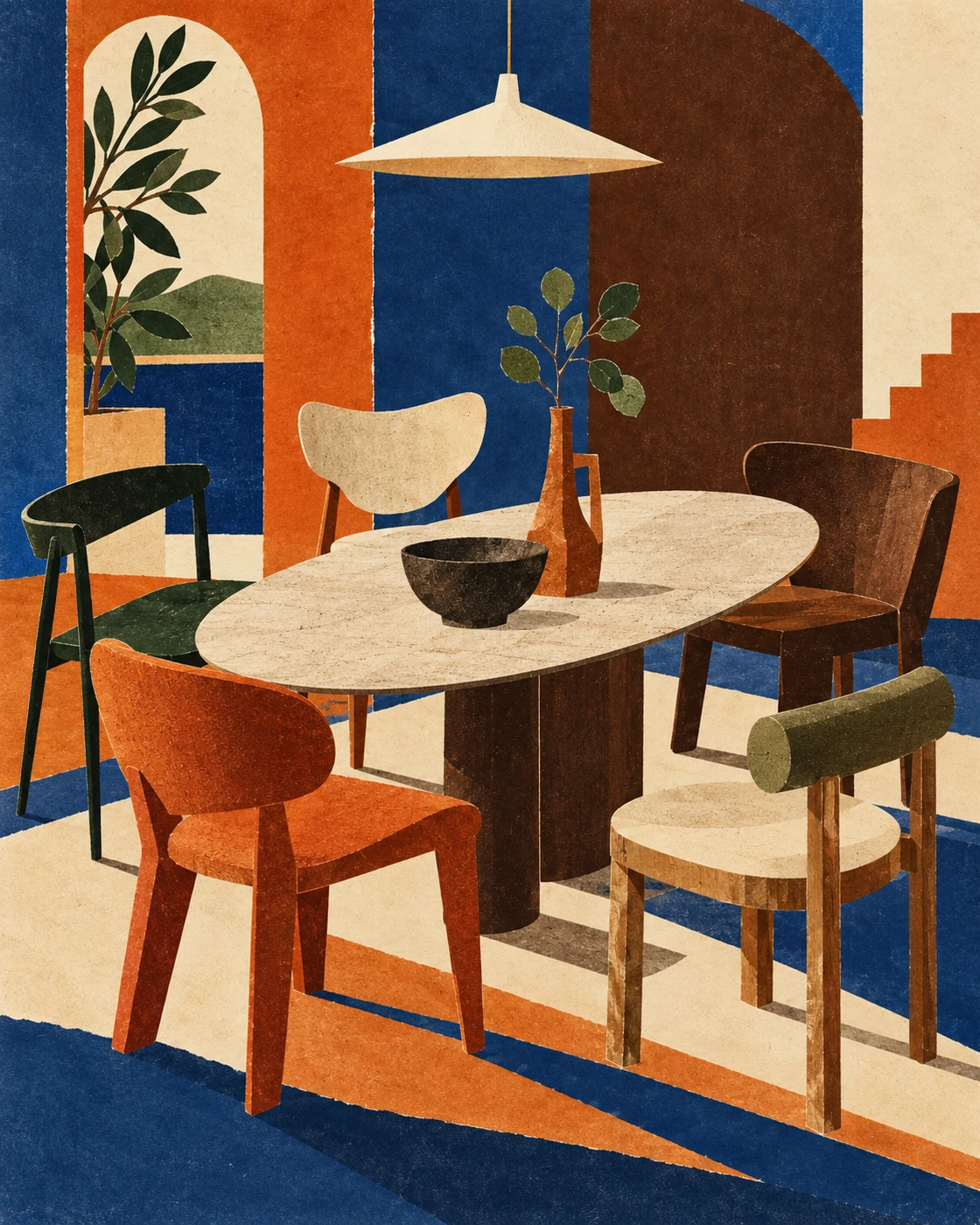
You recognise it immediately: the chair chosen for its outline that makes someone shuffle sideways every evening, hits the wall or leaves knees too close to the top. The model is not always at fault. More often, the issue is the relationship between width, depth, seat height, table apron and pull-back space. An elegant dining room is not created by lining up six important objects like a showroom. It begins when the body moves naturally and the composition remains legible even when the seats are empty. Before buying, design the gesture: sitting down, drawing closer, standing up, passing behind a guest and lingering in conversation longer than expected.
Start with the table, but measure the person
Record the tabletop height, edge thickness and any apron beneath it. Two tables of equal height can offer very different legroom. As a practical check, make sure the distance between the seat and the underside lets thighs move freely; do not rely only on the chair’s overall height. With armrests, confirm that the chair can slide under the top when you want it tucked in.
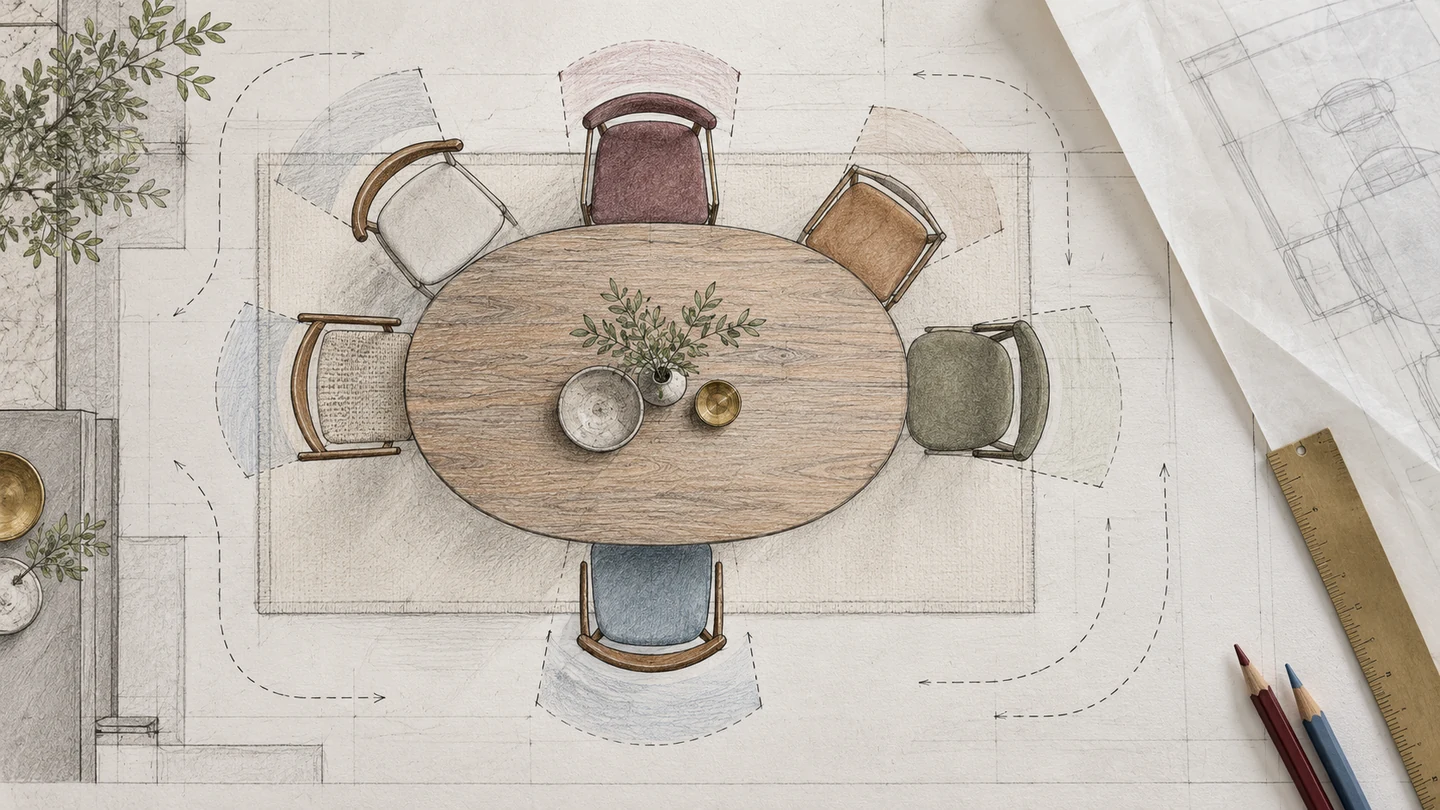
Nominal width does not tell the whole story. A 50-centimetre shell with splayed legs may occupy more floor area, while a wraparound armchair needs more lateral breathing room than an armless chair. Tape the real footprint onto the floor and add its pulled-back position. This simple test reveals whether you are designing for six comfortable people or six motionless silhouettes.
Design three clearances, not just one
The first space sits between chairs and prevents compressed elbows. The second allows the chair to move back. The third is the route behind someone already seated. That last dimension changes when there is a wall, a sideboard door or the main path to the kitchen. In a compact room, removing one seat can improve daily life more than buying a marginally smaller table.
There is no universal magic number because body size, chair base, routine and obstacles differ. Build a full-scale test with an existing chair and boxes representing the table and sideboard. Watch who serves, who stands most often and where a child passes. The scheme works when it solves an ordinary evening, not only a photograph in which everything is perfectly aligned.
Backrest and seat decide how long you will stay
A very upright back can support a short meal yet tire the body during a long conversation; slight flex or a controlled angle can follow it more gently. Seat depth must also suit the user: a front edge pressing behind the knee may indicate excessive depth, while too little support can feel shallow. Technical sheets matter, but they do not replace trying the chair whenever possible.
Upholstery is not an automatic guarantee of comfort. A well-shaped shell can distribute weight precisely; an overly soft cushion may sink and alter the useful height under the table. If the dining area also hosts homework or laptop sessions, prioritise continuous support, smooth edges and a surface that does not force constant repositioning.
Choose materials for the life of the room
Polypropylene and technopolymers are practical and enable complex forms, but matt, glossy and transparent finishes respond differently to scratches, raking light and fingerprints. Wood and veneer add warmth; metal and aluminium may look visually lighter or more sculptural. Do not decide from a material name alone: check finish, care instructions and the use stated by the manufacturer.
With children or everyday meals, accessible joints and washable surfaces reduce effort. A transparent chair does not truly disappear: it reflects windows and lamps and can become the focal point. A perforated structure lets light through while casting pronounced shadows. View a sample in daylight and under the evening light actually used at the table.
Matching set, different end chairs or a controlled mix?
When the table already has a sculptural base or expressive grain, one repeated chair can calm the room. Two different end chairs work when they share at least one feature with the others: colour, back height, material or geometry. Mixing six models requires more discipline, not less. Restrict the palette and keep seat height coherent so that variety looks deliberate.
Avoid placing a separate design icon on every side of the table: too many statements cancel one another. A single expressive model repeated creates rhythm; a special pair at the ends establishes hierarchy. If you own inherited chairs, do not hide them. Connect them through one colour or a new table finish. Prestige comes from relationships, not accumulation.
The expensive mistakes happen before delivery
Buying six chairs without testing one is the main risk. Others include forgetting the table apron, measuring only the shell, ignoring the sideboard door and trusting a screen colour. Load rating, assembly, stability on your floor and indoor or outdoor use also belong to the exact variant’s specification.
Order a sample when the retailer allows it, or begin with one chair under clear return conditions. Photograph it from the entrance, kitchen and living area, then use it through a complete meal. This is not indecision; it is the least expensive way to learn whether an admired shape genuinely supports the way you live.
Objects selected for the project
Five chairs with different personalities and behaviours: they are alternatives, not a set to buy together. The selection compares visual presence, footprint, material and use. Before ordering, verify authenticity, variant, dimensions, seller terms and actual availability on Amazon.it.
Kartell Masters 5865 — the graphic gesture
Designed by Philippe Starck with Eugeni Quitllet, its back interweaves memories of three twentieth-century chairs. Stated dimensions are approximately 53.5 × 55 × 83 cm; it is light, stackable and intended for outdoor use too. Around a simple table it becomes the focal gesture without upholstery. Its limit is the same graphic strength: beside an elaborate base or richly decorated wall it can create noise. Choose it to give identity to a restrained room and verify the exact finish.
Find the model on Amazon.itVitra Panton Chair — the continuous silhouette
The current matt polypropylene version revisits Verner Panton’s famous cantilever chair, produced by Vitra as one continuous profile. Gentle flexibility and an anthropomorphic form explain why it is more than sculpture; the maker also specifies temporary or seasonal outdoor use. It needs visual space, however: the full curve occupies more of the scene than slender legs. It is convincing at the ends of the table or as a monochrome series beside a very simple top.
Find the model on Amazon.itMagis Chair_One — voids, shadows and aluminium
Konstantin Grcic designed an almost architectural die-cast aluminium shell, supported in the four-leg version by aluminium profiles. It is stackable and suitable outdoors. The openings lighten the view and cast interesting shadows beside concrete, dark timber or metal. Its geometry is assertive and should be tested: anyone seeking softness may prefer the compatible cushion or another shell. This is a precise choice for industrial and contemporary rooms, not a universal neutral.
Find the model on Amazon.itPedrali Gliss 921 — the embracing armchair
A wraparound polycarbonate shell and a 10 mm steel-rod sled base create a visually welcoming seat. The back opening makes it easy to grip, while its arms and width require careful checks against the table apron and spacing between diners. It works well at the ends or around a generous table; it may be too present in a narrow room. Choose it when you want guests to linger without moving to a fully upholstered dining chair.
Find the model on Amazon.itKartell Louis Ghost — transparency with a classical memory
Philippe Starck translates the Louis XV armchair into polycarbonate moulded as a single piece. Arms, medallion back and transparency make a recognisable contrast: useful when you want a classical outline without adding another solid colour. It does not truly vanish; light, reflections and fingerprints keep it visually active. Check that the arms fit beneath the top and combine it with a few clear materials. It can lighten a historic room or add wit to a contemporary table.
Find the model on Amazon.itAdvertisement · Product links are Amazon affiliate links. As an Amazon Associate I earn from qualifying purchases. Prices and availability may change.
Sources and specifications
Official specifications and Amazon.it links consulted on 3 October 2026. The Amazon link opens a model search: check seller, variant, components and availability before buying.
Test the room before choosing the chair
White Diamond can verify footprints, circulation and the relationship with your table and sideboard on the floor plan, then create comparative renders with different models, colours and arrangements. The decision no longer depends on an isolated product photograph: you see how the dining room will actually be lived in before buying the same mistake six times.
Request your personalised quote