
Dining table: shape, dimensions and clearances for a confident choice
The right table is not merely the one that fits in the room; it is the one that lets everything around it happen naturally.
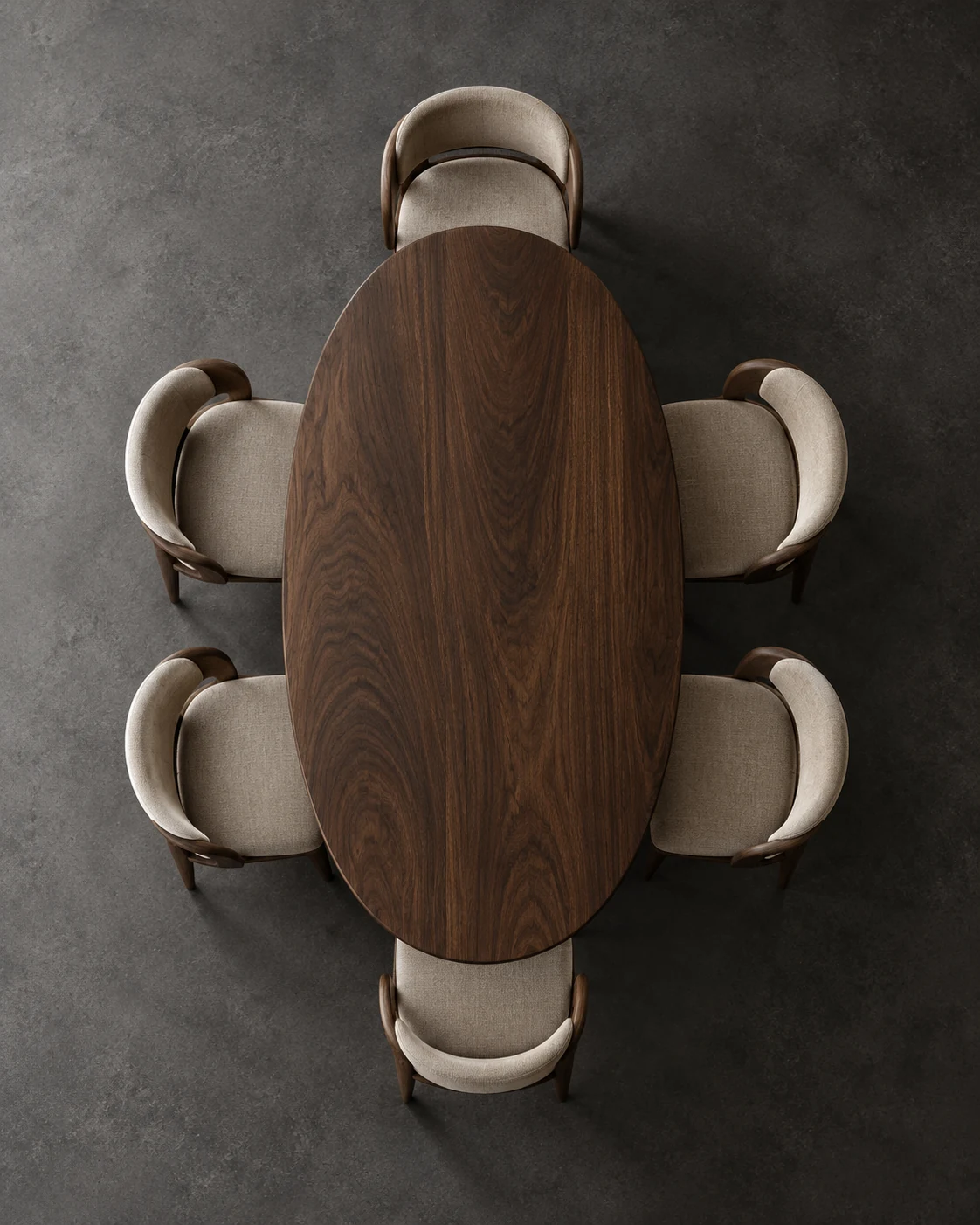
It happens often: the table looks beautiful on the product page and technically fits the room, yet once assembled every movement becomes awkward. A chair hits the wall, the route to the kitchen narrows and the extension can only open after half the living room has been moved. The problem is rarely the table alone. It is the unplanned space around it. A dining area is a small piece of domestic architecture, accommodating bodies, movement, light, conversation and objects. Choosing well means measuring not only the top, but also what happens when someone sits, stands, serves a dish or crosses the room.
Design the empty space before the furniture
Begin with a simple plan marking doors, windows, radiators, opening furniture and main routes. Measure at several points: walls may not be perfectly parallel and skirting boards reduce usable space. Reproduce the tabletop outline on the floor with removable tape, then add the area of the pulled-out chairs. Walk around it, open doors and cupboards, and carry a tray from the kitchen. This test reveals more than one isolated dimension.
As a design reference, one diner generally needs about 55–60 cm of usable edge; allow 60–70 cm for greater comfort, especially with wide chairs or armrests. Behind an occupied chair, 75 cm may work where nobody passes. Where that side is a regular route, aim broadly for 90–110 cm. These are not universal rules: test body sizes, chair type and real habits.
Rectangular, round, oval or square?
A rectangular table organises long rooms and aligns naturally with linear kitchens, media walls and rugs. It provides generous usable edge, but its corners can harden a narrow route. A round table encourages conversation and softens a square room or circulation junction; as its diameter increases, however, reaching the centre becomes harder.
An oval preserves much of a rectangle’s capacity while accommodating diagonal movement more gently, which is valuable in open-plan spaces crossed by daily routes. A square feels intimate and balanced but needs generous space beyond four diners. Do not select a shape only because it repeats the room: an oval may elegantly interrupt a rigid grid, while a rectangle can give direction to an undefined area.
The base matters as much as the top
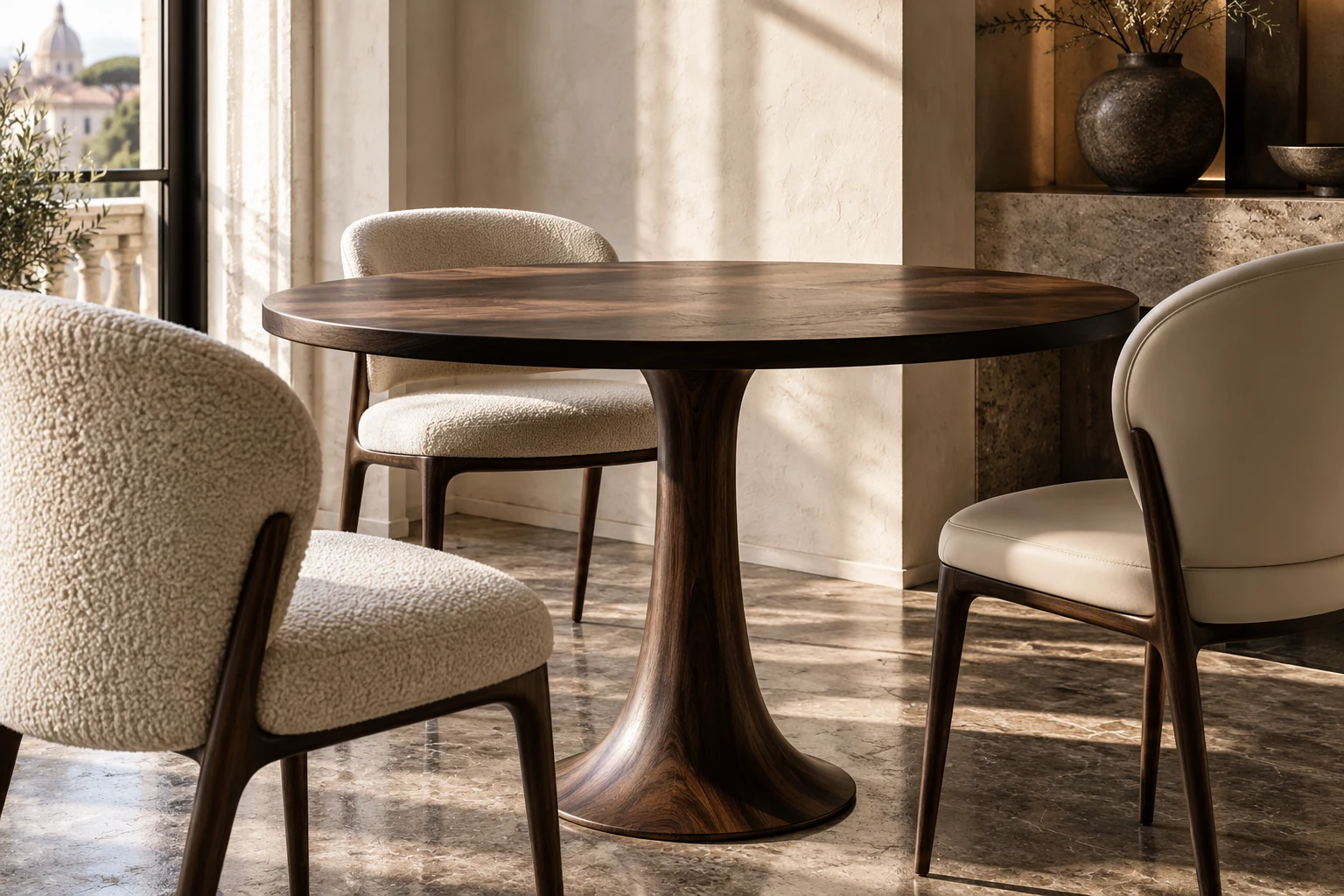
Four corner legs are clear and structurally familiar, but they reduce freedom at the ends. A central pedestal makes chair placement more flexible and can allow an occasional extra place; its stability and foot clearance still need checking. Trestles and crossed structures have character, yet may interfere with knees and feet before they become an aesthetic issue.
Check the clear height beneath the top, edge thickness and rail position. An armchair must approach without colliding. Pair the actual chair with the table before ordering: seat height, backrest angle and depth alter the footprint far more than a frontal product photograph suggests.
An extendable table works only when the transformation is designed
An extending table is useful when the home alternates between everyday life and entertaining. Measure its maximum configuration, decide where extra chairs will come from and ensure that routes to the kitchen, bathroom or balcony remain open. If extension requires rotating the table, moving a fixed pendant or blocking a door, its flexibility is theoretical.
Ask where leaves are stored, how heavy the mechanism feels and whether one person can operate it. Check grain continuity and leg positions when extended. A well-proportioned everyday table with an extension that genuinely works is usually more elegant than an oversized surface that stays empty and dominates the room.
Three tools for testing the plan at home
No elaborate kit is needed. A precise measuring tool, visible tape and suitable floor protection turn an idea into a physical test. The following selection does not replace a professional survey and does not include the table itself: it helps check dimensions, simulate the footprint and protect the floor once the dining area enters daily use.
The White Diamond selection
Our selection begins with the table because it defines how the dining area works and feels. The centrepiece completes its presence; measuring tools, tape and pads help check the choice and installation. Test the guest configuration before deciding: a beautiful table must still leave the room usable.
Advertisement · Product links are Amazon affiliate links. As an Amazon Associate I earn from qualifying purchases. Prices and availability may change.
Mobili Fiver Emma · 160–240 × 90 cm
The crossed legs turn the support into an architectural feature: consider Emma when the table needs to give the dining area its identity. Its extending format accommodates more guests without keeping a large top open every day. Mark both sizes on the floor and check that chairs and knees clear the supports. Pair it with visually light seating and a restrained pendant; check the selected finish in the listing rather than assuming solid timber.
Explore the product on Amazon.it ↗Alessi Mediterraneo · ESI01/29
A centrepiece gives a table character even between meals. Mediterraneo’s branching design creates a sculptural presence while its open structure keeps the surface visually light. Choose it for one clear focal point rather than many small objects; pair it with matte ceramics to balance the metal’s reflection. Check its footprint and care instructions: a narrow table still needs room for serving and conversation.
Explore the product on Amazon.it ↗Bosch Zamo 4 Set · laser measure up to 25 m
A compact laser measure for quickly recording walls, recesses and distances between furniture. Bosch states a range up to 25 metres, area calculation, recent-value memory and line, wheel and tape adapters in the set. It is useful when comparing configurations without relying on rough notes. Confirm the exact Amazon.it variant: a laser reading does not replace manual checks around corners, skirting and uneven walls.
View on Amazon.itScotchBlue multi-surface · 48 mm tape
Use it to outline the table and pulled-back chairs on the floor before buying. The identified listing is a three-roll set, each 48 mm × 41 m. First confirm compatibility with the floor finish: test an inconspicuous area, leave it only as long as needed and remove slowly according to the manufacturer. Do not apply it to fragile surfaces without confirmation.
View on Amazon.ittesa Protect · self-adhesive felt pads
A simple protection for chair and table contact points, particularly where furniture moves often. Select a size and thickness that matches the foot, clean the substrate and periodically inspect wear and trapped grit. Felt pads can reduce friction and noise, but cannot correct an unstable leg and are not suitable for every floor; check the selected variant’s instructions.
View on Amazon.itAdvertisement · As an Amazon Associate I earn from qualifying purchases. Check the variant, dimensions and terms in the seller’s listing.
Light, rug and visual centre
The pendant should follow the centre of the table in its most frequently used configuration, not automatically the geometric centre of the room. Too high and it loses intimacy; too low and it interrupts sightlines. As a design starting point, many arrangements work with the lower edge roughly 70–90 cm above the top, adjusted for beam, users’ height and the chosen fitting.
A rug should accommodate chairs when pulled back. A short edge looks unstable and catches rear legs. Test with the actual chair and consider cleaning: beneath an everyday table, appearance, maintenance and grip must form one decision.
Budget for what you touch every day
Distribute the budget across top, structure, mechanism and chairs. A precious surface does not compensate for an uncomfortable base; a weak extension will rarely be used. Request samples, care instructions, declared load and assembly conditions. For wood and veneer consider heat, light and liquids; for stone and ceramic inspect weight, edges and support.
Before ordering, write a small specification: closed and open dimensions, everyday and occasional seats, minimum space behind chairs, width of the main route and extension storage. Once those facts are clear, style can express itself without sacrificing comfort. Authentic luxury at the dining table is being able to sit without asking permission from the room.
Sources and further reading
A table that leaves room for people
A dining area succeeds when furniture stops being an isolated object and joins a rhythm: approach, sit, share and move through. White Diamond can study shape, materials, lighting and layout through plans and visualisations, so the beauty you imagine matches the comfort you will live with.
Let’s design your dining area