
Coffee table design: distance, height and composition for a truly functional centre
A coffee table is small only in scale. Every day it determines where things land, how people move and whether the room feels composed or obstructed.
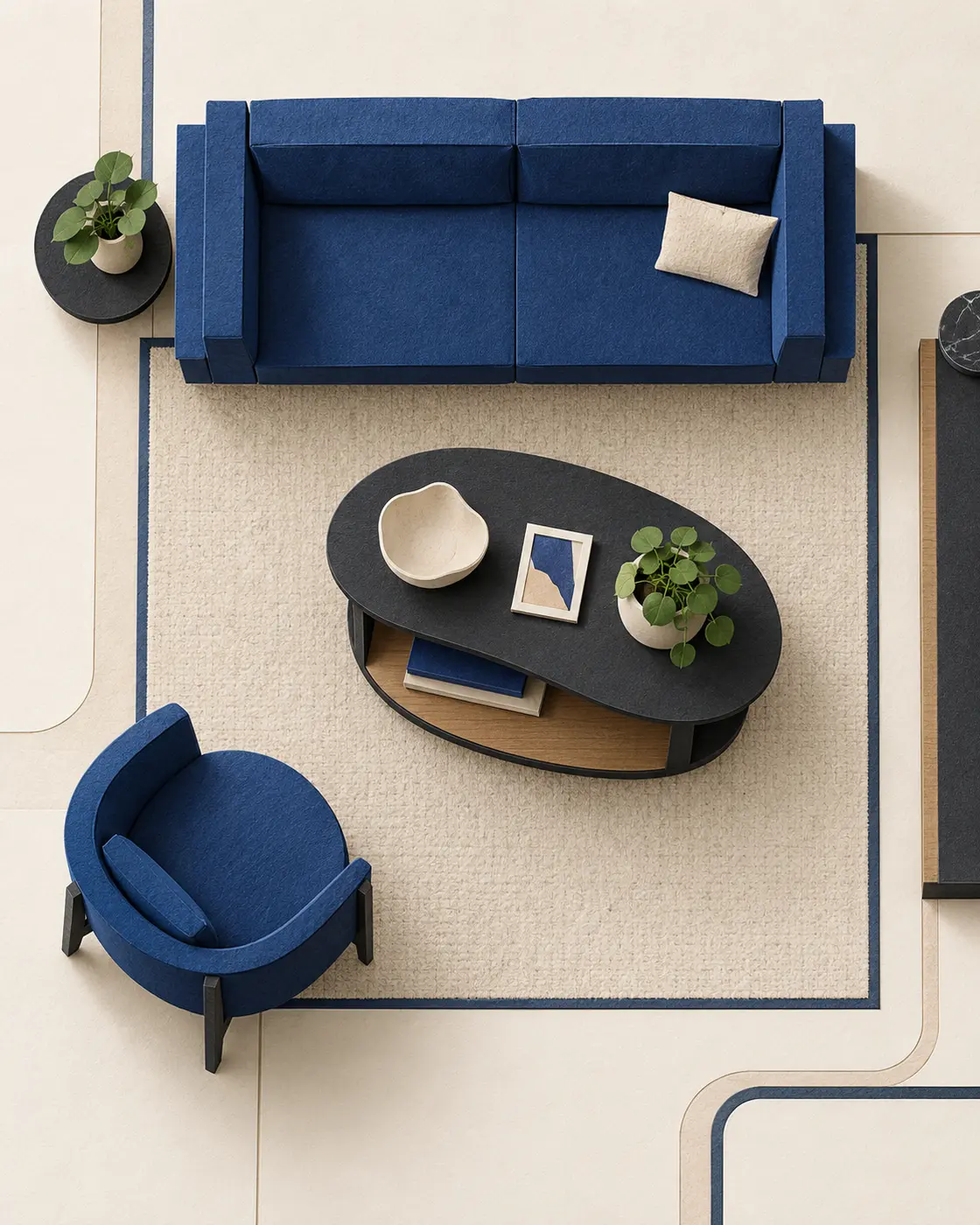
You choose it because it looks beautiful, then discover that reaching it requires too much bending, circulation becomes narrow and every evening it fills with remotes, cups and chargers. A coffee table appears to be a simple purchase, yet it occupies the most sensitive part of the conversation area: the space between sofa, chairs and routes. Before choosing a shape, ask what movements it must support. A successful design does not turn the surface into a static display. It gives it a purpose, lets the surrounding space breathe and selects a few objects that add identity without taking everyday life off the table.
Start with the scene, not the catalogue
Photograph the living room from its entrance and your most-used seat. List what actually happens there: setting down a drink, serving food, reading, children playing or keeping the centre clear. A perfect table for a formal room may be wrong where the rug becomes a play area every evening.
Mark the tabletop footprint on the floor with masking tape, avoiding delicate finishes. Sit, stand and cross the room carrying a tray. If you need to twist or constantly move the table, decoration will not solve the problem. Reduce the footprint, change shape or consider two light elements instead of one dominant volume.
The right distance begins with movement
No universal measurement suits every sofa and person. As a design reference, many rooms work with roughly 40–50 centimetres between seat and table, but sofa depth, user height and circulation may require something different. A physical test matters more than the formula.
Sit with your back in its normal position and reach for an object on the nearest edge. The movement should remain natural without lifting your body. Check freedom for knees and feet. If the table also borders a route, test it while someone is seated: a distance comfortable for reaching may still be too narrow for passing.
Height should converse with the seat
A top near seat height creates an orderly relationship and supports many movements; slightly lower can feel elegant if it does not make every reach uncomfortable. A table markedly higher than the sofa tends to interrupt sightlines. Compare it with the cushion when compressed by a person, not only with its nominal measurement.
If you regularly eat or work there, do not adapt your body for hours to low furniture. Use a dedicated support or an adjustable piece designed for that task. Versatility does not mean making one object do everything; it means giving each activity a suitable support that is easy to store.
Shape and base govern circulation
A rectangle follows a linear sofa, though corners need care in tight routes. An oval keeps direction while softening movement; a round top can connect chairs on several sides. A square works best in a compact, deep arrangement. Look at the base before the top: curved legs, a central pedestal or perimeter frame change foot room and cleaning access.
Draw the opening of any storage and the area occupied by a lower shelf. A second level helps only when stored objects remain accessible and visually controlled. If it becomes an undefined deposit, reduce the selection and assign a clear purpose: current books, one low basket or genuinely used tools.
Rug, light and materials must collaborate
The table does not float alone: it sits on a rug, reflects a lamp and converses with sofa and floor. Over a strong texture, a simple silhouette avoids competition. In a very smooth room, timber, metal or a tactile finish can add depth. Check weight, suitability and maintenance; a delicate surface at the centre of daily life may create more anxiety than pleasure.
Side light should reveal objects without glare. With two open levels, leave one zone empty: negative space makes the form legible and preserves somewhere to put things without dismantling the composition. Elegance is not the same as filling every surface.
A composition in three movements
Divide the top into three zones: a vertical or sculptural object, a lower element and free surface. The first gives rhythm, the second gathers or supports and the third protects function. Avoid centring everything like a showroom. Shift the focal point slightly and check it from both sofa and entrance.
A tray is optional but can gather small objects and make the table quick to clear. A frame brings personal memory; a compact planter adds living material when light and watering suit it. A centrepiece must preserve conversation: if it hides someone opposite or occupies the useful landing area, its scale is wrong.
Four choices that build the design
The selection below is not intended to fill the table. Each piece has a different role: structure, focal point, personal memory and planting. Before buying, check dimensions, variant, stated materials and care on Amazon.it. Links are affiliated, while the selection remains design-led.
You do not need to buy them together. Choose the item that solves the main problem, then live with the new arrangement before adding anything else. One well-positioned object can create more character than four accessories bought at once.
Budget: spend where contact is daily
Invest first in stability, proportion and surface. These are the qualities you touch every day and that determine usable life. Decoration comes later and can grow slowly. If the existing table is solid and well sized, empty it, rotate it or reorganise its lower level before replacing it.
Consider delivery, assembly, weight and mobility alongside price. With children, pets or heavily used routes, edges, stability and finishes need specific checking. No accessory is universally essential; it becomes valuable when it removes a genuine friction and supports the atmosphere you want to inhabit.
The final test lasts one week
Live with the arrangement for seven days using placeholders or your current table in its new position. Each evening, note what remains out of place. Repeated accumulation may not be mere untidiness; perhaps an accessible destination is missing. If the centre stays free but the table is never reached, it may be too far away or unnecessary.
A well-designed living room does not need restaging after every use. It receives a cup, a book and a conversation without losing clarity. The right coffee table has character, but convinces mainly because movement around it becomes easy.
The White Diamond selection
The coffee table is the main piece; the other objects support its use without taking over the surface. Choose one sculptural accent and add a frame or plant only if everyday space and sightlines remain clear. This hierarchy, rather than the number of purchases, gives the living-room centre character and comfort.
Objects selected for the projectAdvertisement · Product links are Amazon affiliate links. As an Amazon Associate I earn from qualifying purchases. Prices and availability may change.
Umbra Bellwood Coffee Table · 109 × 55 × 40 cm
Curved legs and two open tiers give this table a recognisable presence without closing its volume. Consider it for a warm visual centre and a lower shelf reserved for a few books or one low container. Mark 109 × 55 cm on the floor: it may dominate a compact room. Echo its timber tone in just one other element, then check the listing for variant, assembly, load and care.
View on Amazon.itAlessi Mediterraneo · ESI01/29 centrepiece
Its branching design turns a container into a sculptural accent, effective when the top needs one focal point rather than many ornaments. The open structure stays visually light, but its diameter must leave free landing space. Pair it with matte books or textiles to balance the metal reflection. Check finish, dimensions and maintenance for the offered variant.
View on Amazon.itUmbra Prisma · black 20 × 25 cm frame
A personal photograph prevents the composition feeling anonymous, while the geometric frame adds depth. Use it on the lower shelf or a nearby console if the main top must stay clear; avoid exposed positions vulnerable to knocks or spills. Choose a simple image and echo black in one other room detail. Check usable picture size and display method; your chosen print is not automatically included.
View on Amazon.itLECHUZA CUBE Glossy 16 · white, 13520
A compact planter can bring greenery without turning the table into a jungle. CUBE Glossy 16’s clear geometry suits one proportionate plant placed where suitable light reaches it and sightlines remain open. Its watering system may simplify care but cannot replace choosing the right species. Plant not included unless stated; check nursery-pot compatibility and instructions.
View on Amazon.itSources and further reading
Official product pages checked on 1 October 2026.
A centre that leaves room for life
If your living room looks complete yet resists everyday movement, we can study seating, routes, rug, light and furniture before you buy. Design begins with the space that lets people feel at ease.
Tell me about your living room