
Contemporary Mediterranean style: lime, terracotta, timber and shade beyond the postcard
The most elegant Mediterranean interior is not recognised by a shell: it is felt in light, shade and the temperature of materials.
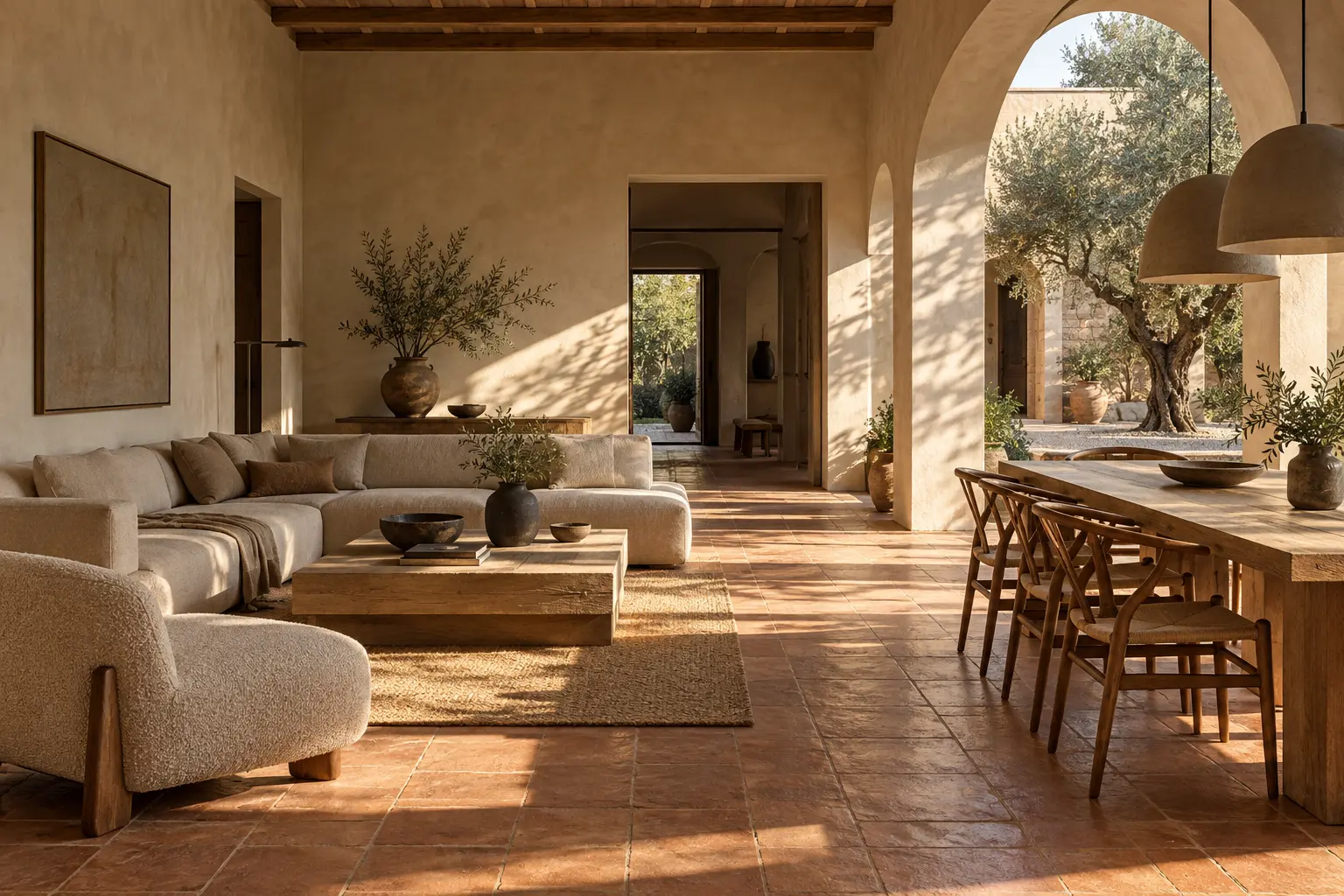
At midday the house does not ask for more light; it asks for shade. A mineral wall holds the glow, terracotta gives warmth underfoot and a light curtain measures the breeze. Contemporary Mediterranean style begins with climate and daily gestures, not a white-and-blue set. Mass, porosity, ventilation and controlled imperfection make a room feel quiet even far from the sea.
Not a theme, but a response to climate
Different Mediterranean traditions share a logic before they share an image: shelter from high sun, catch air, use mass and create thresholds between inside and out. Copying arches, amphorae and blue stripes without that structure produces a set. Contemporary design translates those principles into the home’s real orientation, climate and daily life.
Design shade before colour
Loggias, deep reveals, curtains, shutters and adjustable screens turn sunlight into a controllable material. Good shade does not darken; it reduces glare and lets texture be read. Before choosing the perfect beige, observe where light enters in summer and winter. A warm wall remains refined when the transition from sun to shade has been designed.
Lime and mineral plaster need the right substrate
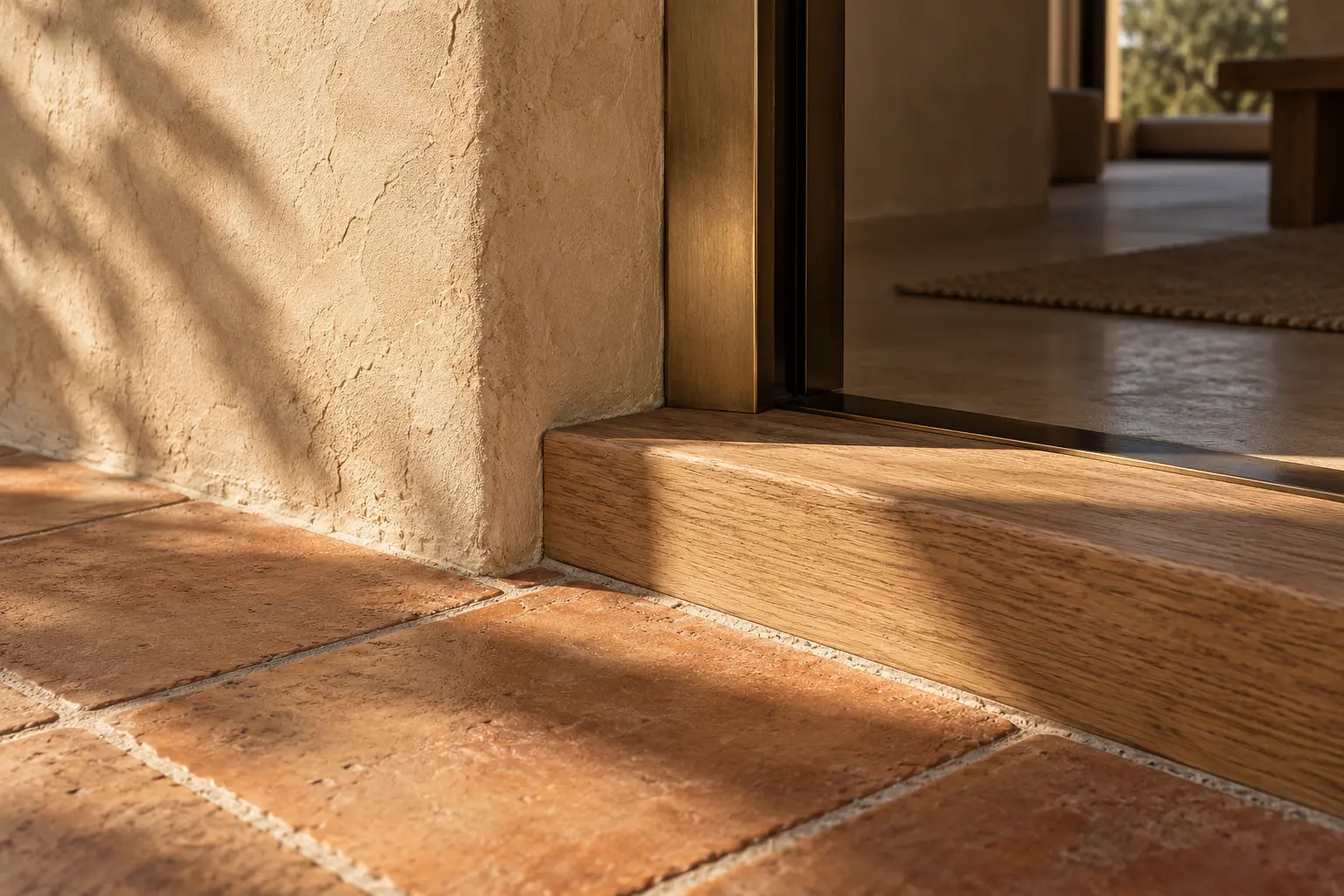
Lime’s vibration comes from irregular refraction, not artificial ageing. Substrate, moisture, breathability and application cycle require professional verification. Large samples reveal absorption, clouding and grazing-light behaviour. Splash- or stain-prone areas need compatible systems: a mineral look never excuses poor performance or maintenance planning.
Terracotta becomes contemporary through precision
Format, laying direction, joint and treatment determine whether terracotta feels current. A simple module, coherent joints and aligned thresholds calm the floor; random borders and direction changes fragment it. Colour variation belongs to the material, while absorption, protection and cleaning must be resolved before installation, not after the first stain.
Timber: fewer species, greater continuity
Pale oak, chestnut, elm or local species warm a mineral base. Coherence matters more than the label: related tones, visible grain, matte finishes and details that accommodate natural movement. Near glazing and thresholds, assess humidity, solar gain and stability. Timber need not look antique to feel Mediterranean; it must age well.
An earthen palette, not fifty beiges
Lime, sand, clay, tobacco, olive and bronze work because their temperatures differ. If every surface has the same value, the room flattens. Build depth with a pale wall, warmer floor, mid-tone timber and a few dark accents. Ceramics and textiles add movable colour so the home can change without losing its architecture.
Open thresholds and real ventilation
Indoor-outdoor continuity is beautiful only when water, levels, tracks, drainage and weathering are resolved. Opposing or high-and-low openings can encourage cross-ventilation, but performance depends on exposure and context. Insect screens, shading and security belong in the design. A Mediterranean threshold is technical before it is photogenic.
Natural fibres, used with restraint
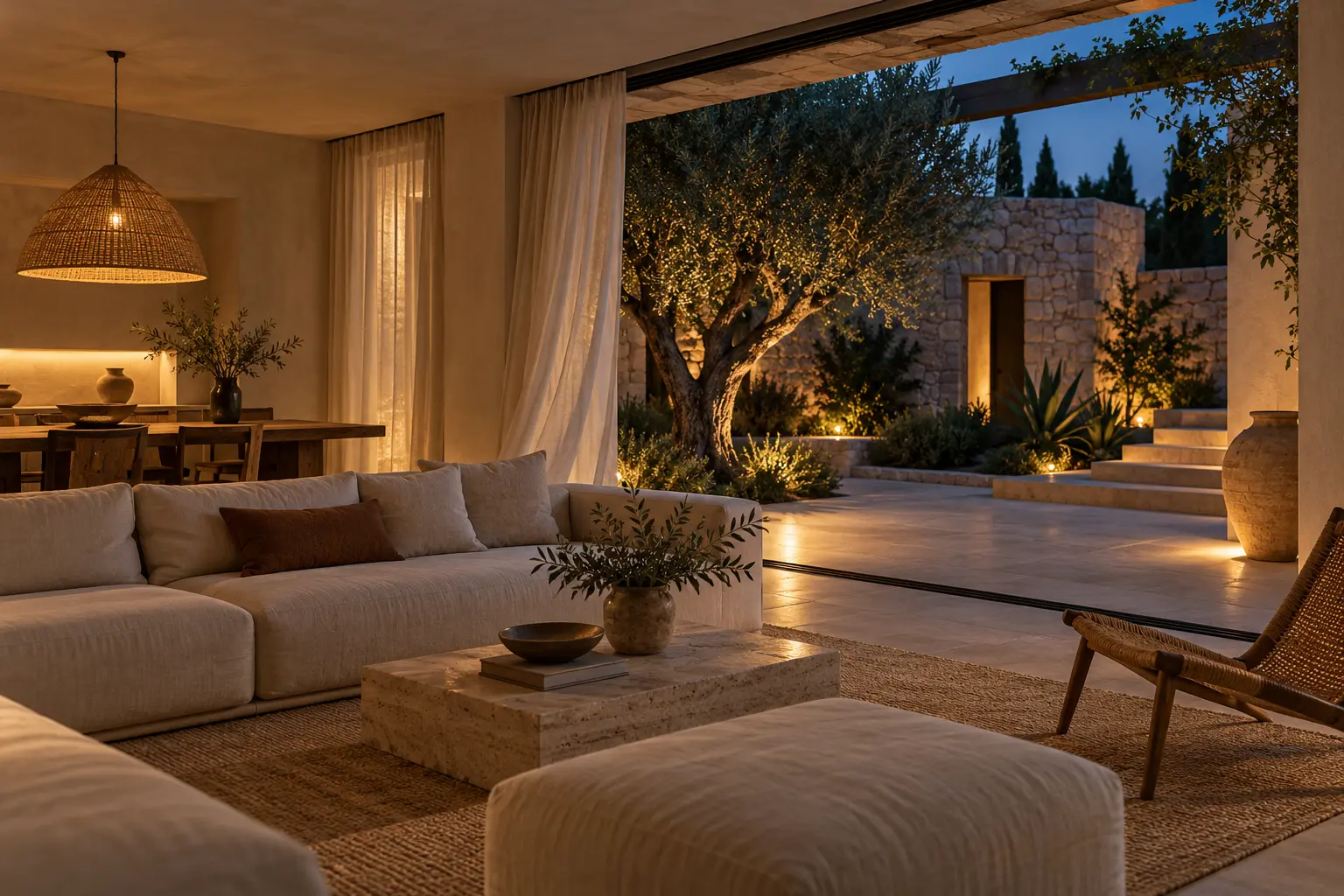
Linen, hemp, jute, rope and woven surfaces soften hard materials but need not appear everywhere. A filtering curtain, a well-scaled rug and one light can be enough. Check light-fastness, cleaning, moisture and fire performance where applicable. Simplicity is not a lack of choice; it is rigorous selection of what ages with dignity.
At night: low, warm and serviceable light
One dramatic pendant cannot build the whole atmosphere. Indirect light on mineral surfaces, points close to tables and accents on planting create depth without glare. Keep drivers accessible, choose coherent optics and avoid excessively cool colour temperatures. The aim is not to light everything, but to support dining, conversation and movement.
In an apartment too, without disguise
A patio and sea view are not required. In an urban flat, a few coherent moves are enough: one well-sampled mineral wall, a warm floor or rug, matte timber, filtering textiles and layered light. Remove themed decoration and work on proportion, shade and touch. The result should express a way of living, not a tourist destination.
Useful tools and accessories
Book on contemporary Mediterranean interiors
Useful for separating spatial, daylight and material principles from superficial decorative references.
View on Amazon.itNatural-fibre pendant light
Can provide soft, tactile light; size, lamp, maintenance and fire performance must be checked.
View on Amazon.itNeutral cleaner for terracotta and stone
Choose it only after identifying the floor finish and treatment, then test in a concealed area.
View on Amazon.itLinen or linen-blend curtain
Filters sunlight without flattening the room; assess weight, transparency and shrinkage on a real sample.
View on Amazon.itAdvertising · Some links are Amazon affiliate links. Selection remains editorial and independent.
Explore the project
Lime paint and light · The terrace as an outdoor room · A veranda for every season · Carlo Scarpa: material and detail · Design quote