One skirting board, two walls and a lesson from Josef Albers
An ivory hallway opens onto a deep teal living room. Will one paint colour work for the skirting in both? Try changing the background behind two strips of the same grey.
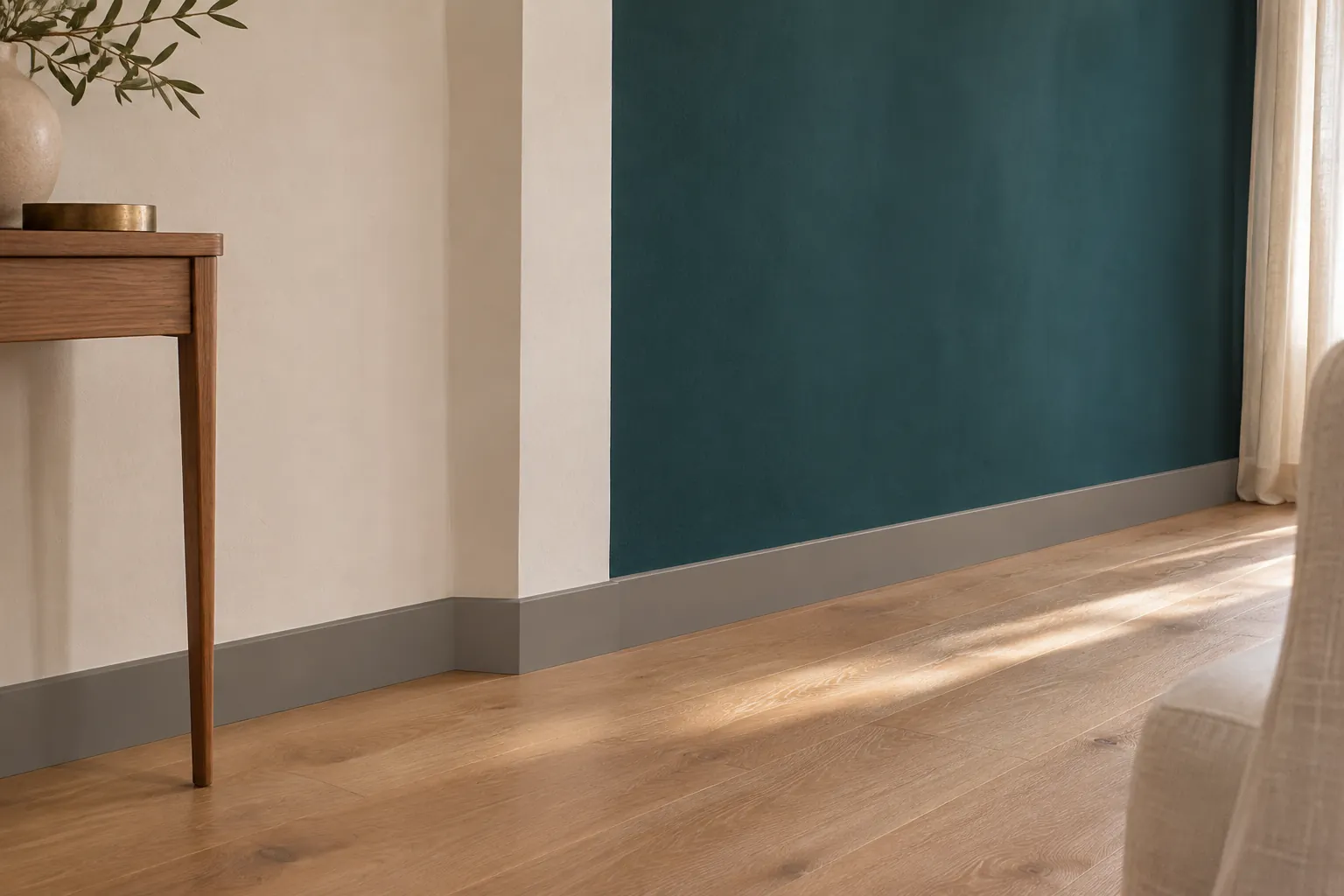
Look from the hallway into the living room and the skirting seems to change at the threshold. Against ivory it reads as a shadow. Against deep teal it turns into a pale ribbon. The painter could have used the same tin all the way through. To decide whether you like the shift, try an exercise that began at a worktable.
What a colour does in company
Yale University Press published Josef Albers’s Interaction of Color in 1963. Its fourth chapter, on the relativity of colour, includes a plate the publisher credits to one of his students. The classroom helped make the book. An exercise the Albers Foundation now calls One Color Becomes Two asks you to make identical samples look different by changing what surrounds them.
Look at the two strips below and pick the one that seems lighter. Switch to the neutral background, then switch back. In a room, the walls will take the place of the two fields of colour.


Test two offcuts side by side
Picture an ivory hall opening onto a teal living room with the same oak floor in both. For skirting 8 cm high, I’d take two lengths of about 35 cm cut from the same profile. Those are example dimensions. Each piece should show enough of the top edge for you to see the shadow it casts.
Give both offcuts the same preparation, paint and number of coats. Once dry, stand them against boards painted in the two wall colours. Keep the boards side by side in the same light, then swap the offcuts. If whichever piece stands against teal still looks lighter, you’ve picked out an effect of the background. If the difference follows the piece, look more closely at coverage and sheen.
Give the change of paint a place to end
Now put one offcut in the hall and the other in the living room. Stand in the doorway and look at them by day, then with the lamps you use in the evening. A glint along the painted edge may draw your eye more strongly than the difference you saw on screen.
If you want a line that follows the floor from room to room, keep a single grey and let it stand out against the teal. If you want the base of each wall to recede, try two colours, each close to the wall above it. I’d make the switch at the edge of the door jamb. Seen from either room, the line then ends where the wall does.
For the profile itself, see the guide to traditional, flush and recessed skirting boards.