
Cleaning marble and natural stone: preserving beauty with care
Before reaching for a stronger product, learn to read the surface. Good maintenance begins with a precise choice rather than greater force.
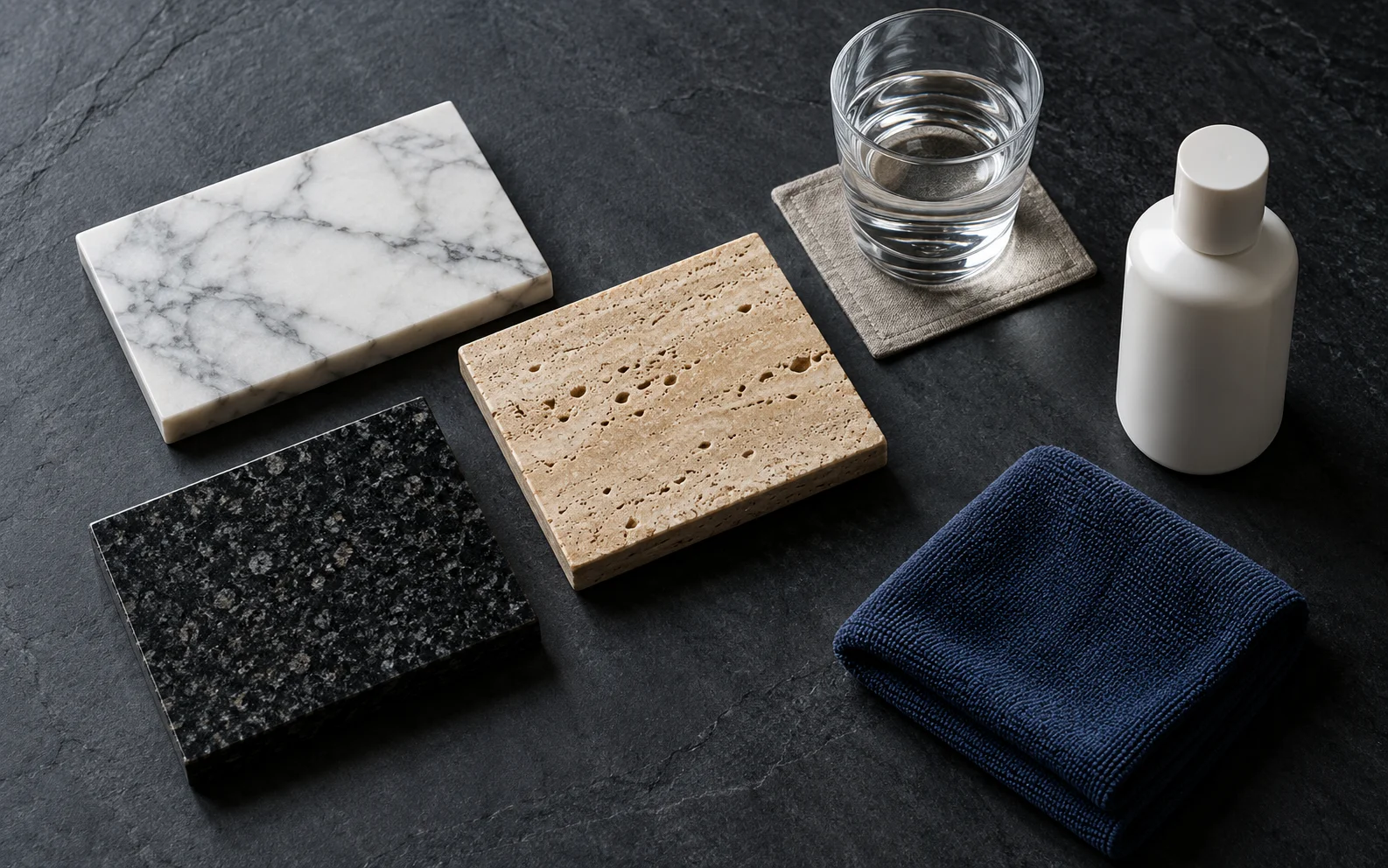
You chose a marble worktop for a vein that seemed to carry a landscape through the room. Then a ring appears beneath a glass, a dull patch beside the sink, a mark that returns when the light changes. The concern is understandable: a loved material suddenly seems difficult to live with. Yet adding cleaner or scrubbing longer often does not solve the problem. First establish whether you are seeing dirt, product residue, an absorbed stain or a change to the finish. These are different conditions and need different responses. An elegant home does not have to become a museum. It needs a manageable care routine, considered alongside its materials.
The first thing to obtain is information
Ask the supplier for the stone’s name, finish and any treatments applied. Polished marble, filled travertine, honed granite and engineered quartz are not interchangeable. Even slabs sold under similar commercial names can behave differently. A photograph cannot reliably identify a material: keep the technical sheet, invoice and installer’s instructions in a small home reference folder.
Calcareous stones are sensitive to acids. Vinegar, lemon and ordinary limescale removers are therefore not shortcuts for marble or travertine. A mainly siliceous stone may also contain sensitive minerals or have a surface treatment with specific restrictions. Start with the surface manufacturer’s instructions, then check the cleaner’s label. The word natural, whether applied to stone or cleaner, is not a guarantee of compatibility.
Read a mark before treating it
Look at the dry area in side light and note what happened before it appeared. A widespread film after washing may result from excessive cleaner or insufficient rinsing. A darker patch after oil or cosmetics may suggest absorption. A dull impression following an acidic substance may instead be etching of the finish. Such clues help describe the issue; they do not replace professional diagnosis.
Begin with compatible routine cleaning in an inconspicuous spot, without abrasives or mixtures. If the mark remains, stop the sequence of experiments. Cleaner cannot rebuild an etched polished finish; rubbing an absorbed stain may simply spread the affected area. Photograph the dry defect and tell the stone specialist its name, the product used and what was spilled. Concrete information allows a more targeted response.
A four-step routine with little product
First remove dust and particles that could be dragged across the surface. Use clean floor tools without worn parts that could scratch; use a dedicated soft cloth on worktops. Blot spills immediately rather than spreading them. It is a small action, but it reduces the time a substance remains in contact with the material.
Then wash with a neutral cleaner explicitly suitable for the surface, diluted according to its label. Measure the dose: more foam does not mean better cleaning, and excessive concentration can leave a film. Rinse where required, replace dirty water and finish by drying with a second clean cloth. Some highly diluted formulations do not require rinsing, but only under the conditions stated by their manufacturer—not for every cleaner or application.
Picture a small marble vanity with a black tap. Keep one cloth for the stone and another for the fittings, because the products suitable for each may differ. Store everything close to the point of use but out of children’s reach. A repeatable routine protects more effectively than occasional lengthy cleaning, particularly in spaces used every day.
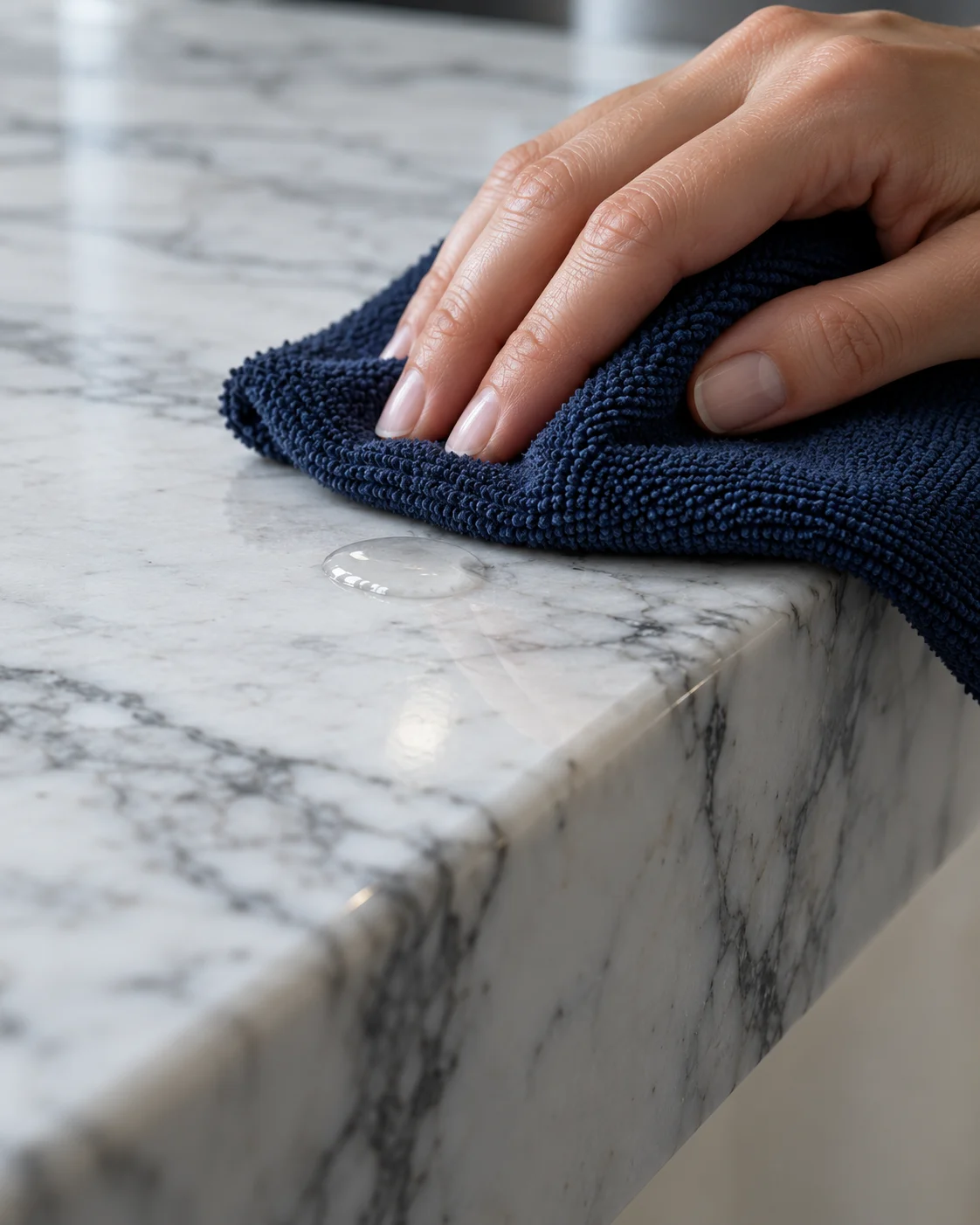
Design prevention without hiding the stone
Place coasters beneath drinks and bottles that may leave residue; use trivets and chopping boards rather than putting hot cookware or food preparation directly on the stone. Choose washable bases, check that they do not trap grit and dry condensation. A well-proportioned tray can organise cosmetics beside the basin, provided it is easy to lift and clean underneath.
For floors, an entrance mat with a suitable slip-resistant backing limits incoming sand. Protect furniture contact points and inspect them periodically: dirty protective pads can drag particles. Keep corners and edges accessible when arranging furniture. Maintenance is also a spatial issue. A permanently crowded worktop makes drying and monitoring the surface unnecessarily difficult.
Three tools with three different jobs
The selection below separates routine washing, maintenance of an existing protective treatment and final drying. You do not need to buy everything. Choose what matches your material and habits, checking the exact variant, instructions and compatibility. Floor cleaner is not automatically the ideal product for a food-preparation worktop; a polishing cloth does not replace restoration.
The White Diamond selection
Compatibility, not product strength, preserves a beautiful surface. This selection distinguishes cleaning, maintenance of an existing treatment and drying nearby elements. Identify the stone and finish first and follow the manufacturer’s instructions: another purchase will not fix damage that needs restoration.
Advertisement · Product links are Amazon affiliate links. As an Amazon Associate I earn from qualifying purchases. Prices and availability may change.
FILA CLEANER PRO · concentrated cleaner, 1 litre
The design decision here is to preserve the surface you already have: an appropriate cleaner helps avoid unsuitable maintenance changing the stone’s character. Select CLEANER PRO according to the actual material and finish, following the manufacturer’s dilution and use instructions. Keep a small organised kit with separate cloths and test an inconspicuous area. It is not a universal remedy for acid etching, deep stains or damage, which may need specialist assessment.
View on Amazon.itFILA MARBLE REFRESH · ready-to-use spray, 750 ml
Designed by the manufacturer to clean and maintain protection on natural-stone worktops already treated with waterproofing products, with guidance also covering marble-resin and quartz-resin. It is relevant when the supplier confirms compatibility with the existing treatment. The ready-to-use formula requires no dilution; FILA instructs users to wipe with a soft dry cloth until completely dry, without rinsing. It is not a universal initial sealer or a remedy for acid marks. Its value lies in maintaining an already appropriate care system.
View on Amazon.itE-Cloth Glass & Polishing Cloth · pack of 4
Reusable microfibre cloths for finishing clean, damp surfaces, with manufacturer guidance for glass, mirrors and chrome. We suggest them for drying glasses and fittings around the stone: fewer droplets and fingerprints on neighbouring elements make the whole worktop look more considered. They are not restoration abrasives or a marble-specific treatment. Keep a cloth dedicated to compatible finishes, wash it as instructed and avoid fabric softener. This is a useful purchase for managing several surfaces, not a promise of identical results on every material.
View on Amazon.itAdvertisement · As an Amazon Associate I earn from qualifying purchases. Check the variant, dimensions and terms in the seller’s listing.
Stain protection helps, but has limits
An impregnating treatment can improve resistance to absorption on some stones. It does not make the surface stain-proof or remove its sensitivity to acids. Different stones need different approaches. Ask the supplier what was applied and when its effectiveness should be assessed, instead of layering products chosen solely for their protective promises.
On food-contact surfaces, a treatment must be suitable for that use and applied according to its instructions and timings. Do not adopt a universal renewal schedule: absorption, finish, traffic and formulation change the outcome. For persistent defects, the cost of informed assessment may be more sensible than a succession of incompatible products.
When the design needs to change, not just the cleaner
In a heavily used kitchen, consider whether you welcome marble’s patina or want a more forgiving surface. Stone-effect porcelain is a design option to assess, but it has its own maintenance requirements and should not automatically be treated like marble. Compare samples, edges, joints and technical sheets. Appearance alone does not describe daily life with a material.
Include routine cleaning, any protective treatment and possible restoration in the budget, alongside the slab price. In a home where children often join in cooking, it may make sense to reserve marble for a less exposed feature and choose another surface for the working zone. Quality grows from the agreement between beauty and habits. The right material is one you can still love after its first day.
Sources and further reading
Beauty that belongs in everyday life
Stone carries light, time and texture. Preserving it calls for informed choices rather than anxious living. White Diamond can help plan surfaces, details and furniture layouts that bring atmosphere, real use and maintenance together, before a material becomes a daily concern.
Let’s discuss your home’s materials