How to choose a mat for a signed print
The frame is the right size. Then the mat goes over the sheet and the tail of the signature disappears. What you see on the wall depends on where the window is cut.
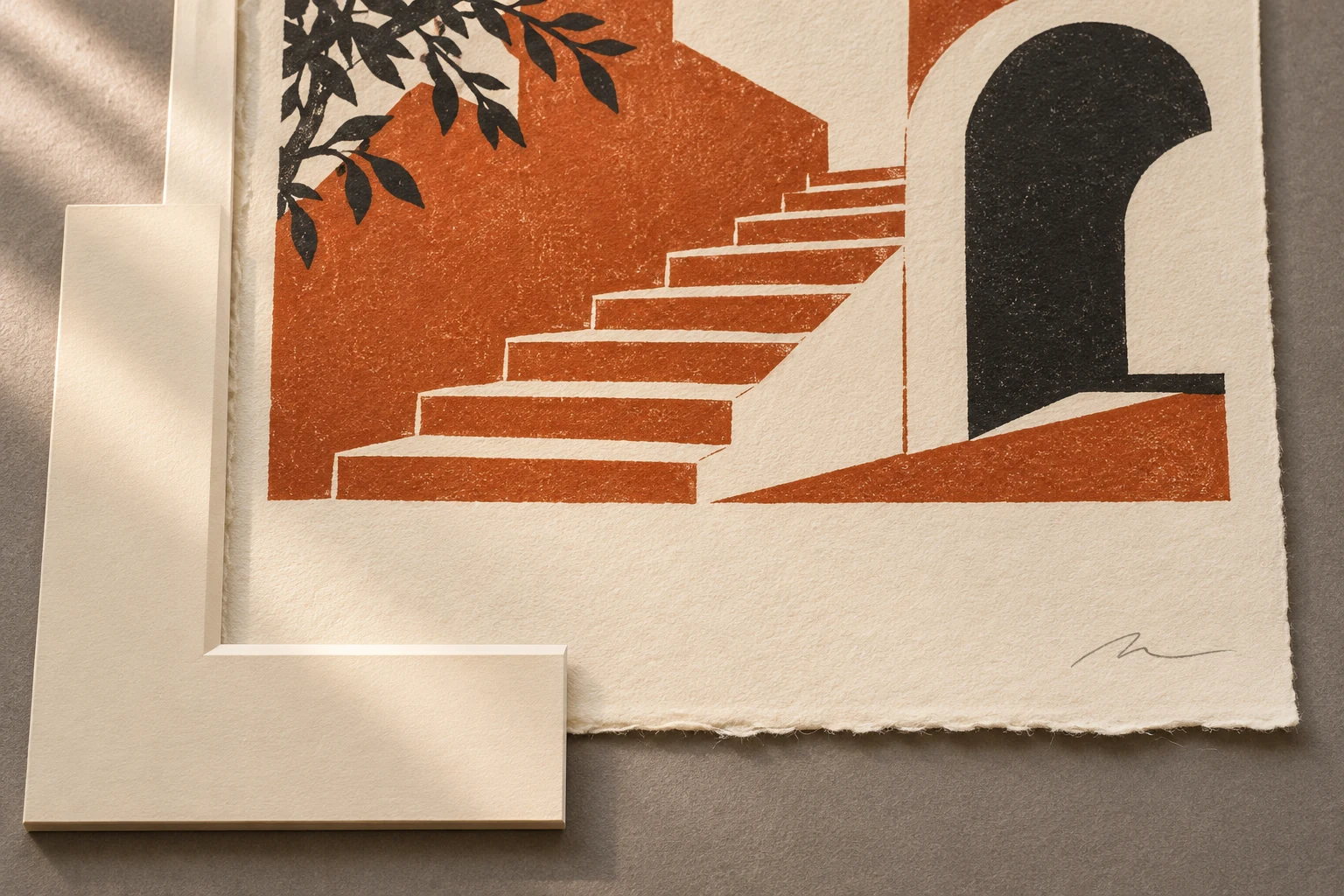
At the frame shop it is tempting to start by laying one length of molding beside the print, then another. Before choosing the wood, look at the paper below the image. Is there an edition number, a penciled dedication or a ragged edge you like? These are the details to keep in sight as you plan the opening.
Whistler’s butterfly
In one impression of James McNeill Whistler’s The Doorway at the Hunterian in Glasgow, the sheet has been trimmed to the plate mark. A small tab of paper, just 6 × 16 mm, projects beyond it. The tab carries a penciled butterfly and the inscription “imp.” A mat cut flush to the image would leave the view intact while concealing the spot where Whistler signed it.
Measure from the edge of the sheet
Measure the sheet in several places, especially if its edges are uneven. Then use a full-size copy to mark the distance from each edge to the image, the signature and any plate mark, the shallow impression the printing plate leaves in the paper. Slide two corners of matboard over the copy to see what the cut will reveal.
A window mat covers part of the sheet. For the simple mount in its guide, the Canadian Conservation Institute gives an overlap of a few millimeters, about 2–4 mm, with significant marks left visible. If you want the entire outline to show, ask for a float mount. Here the window is larger than the sheet, leaving a strip of the backing board visible around the paper.
One print behind three windows
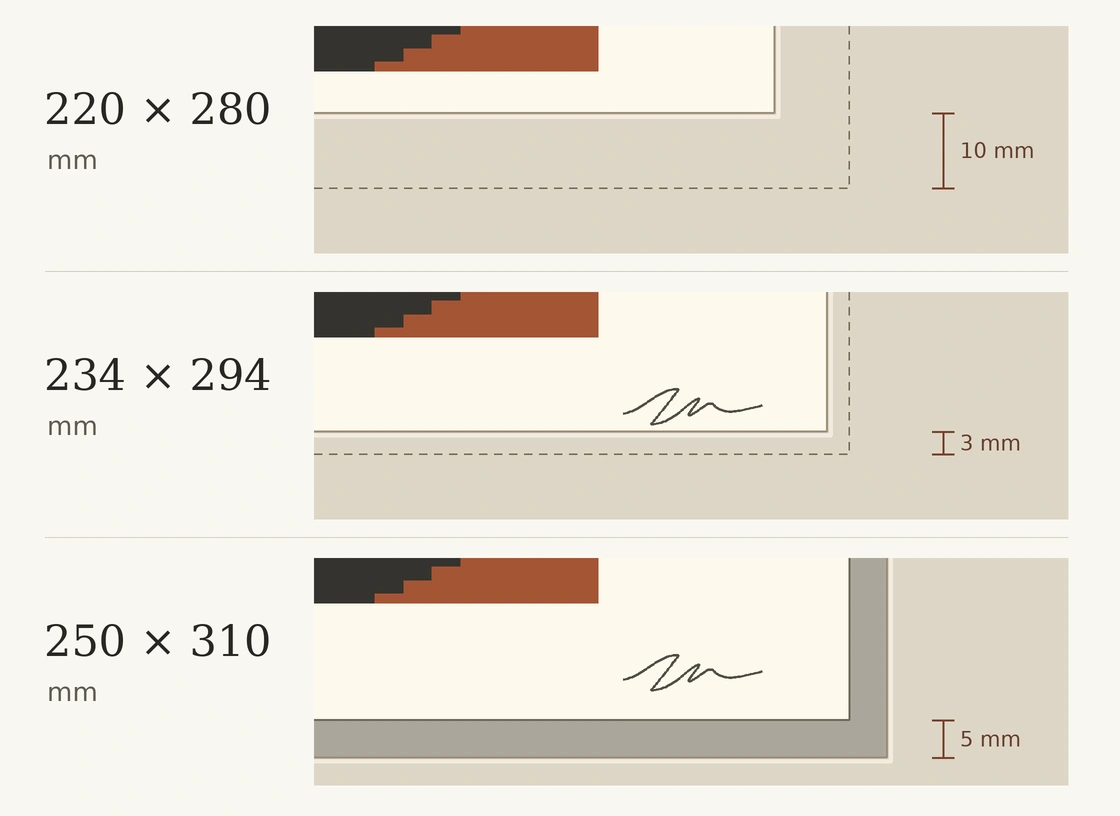
Take a hypothetical 240 × 300 mm sheet. The lowest stroke of the signature sits 4 mm above its bottom edge. With the sheet centered in each opening, the differences are easy to see.
- 220 × 280 mm · The mat overlaps the sheet by 10 mm on each side, hiding the lower part of the signature.
- 234 × 294 mm · The overlap drops to 3 mm per side. The whole signature is visible, with just 1 mm between its lowest stroke and the mat.
- 250 × 310 mm · With the sheet floated, 5 mm of backing shows on all four sides. The paper edge becomes visible too.
What to ask the framer
Choose an overlapping window if the signature has enough room and you want to give a crookedly trimmed edge a clean outline. If the signature sits close to the edge or the shape of the sheet matters to you, try floating it. For the example above, you could ask, “I’d like to see all four paper edges with 5 mm of backing around them.” For an original print, agree on conservation-grade materials, a reversible mount and space between the sheet and the glazing. The marked-up copy lets you approve the cut before handing over the original.
Collection record and framing guides
Once the print is framed, read our guide to placing and lighting artwork at home.