
Arts and Crafts today: character beyond decoration
A room’s value can begin with a well-made joint, a carefully chosen textile and room for the objects that matter.
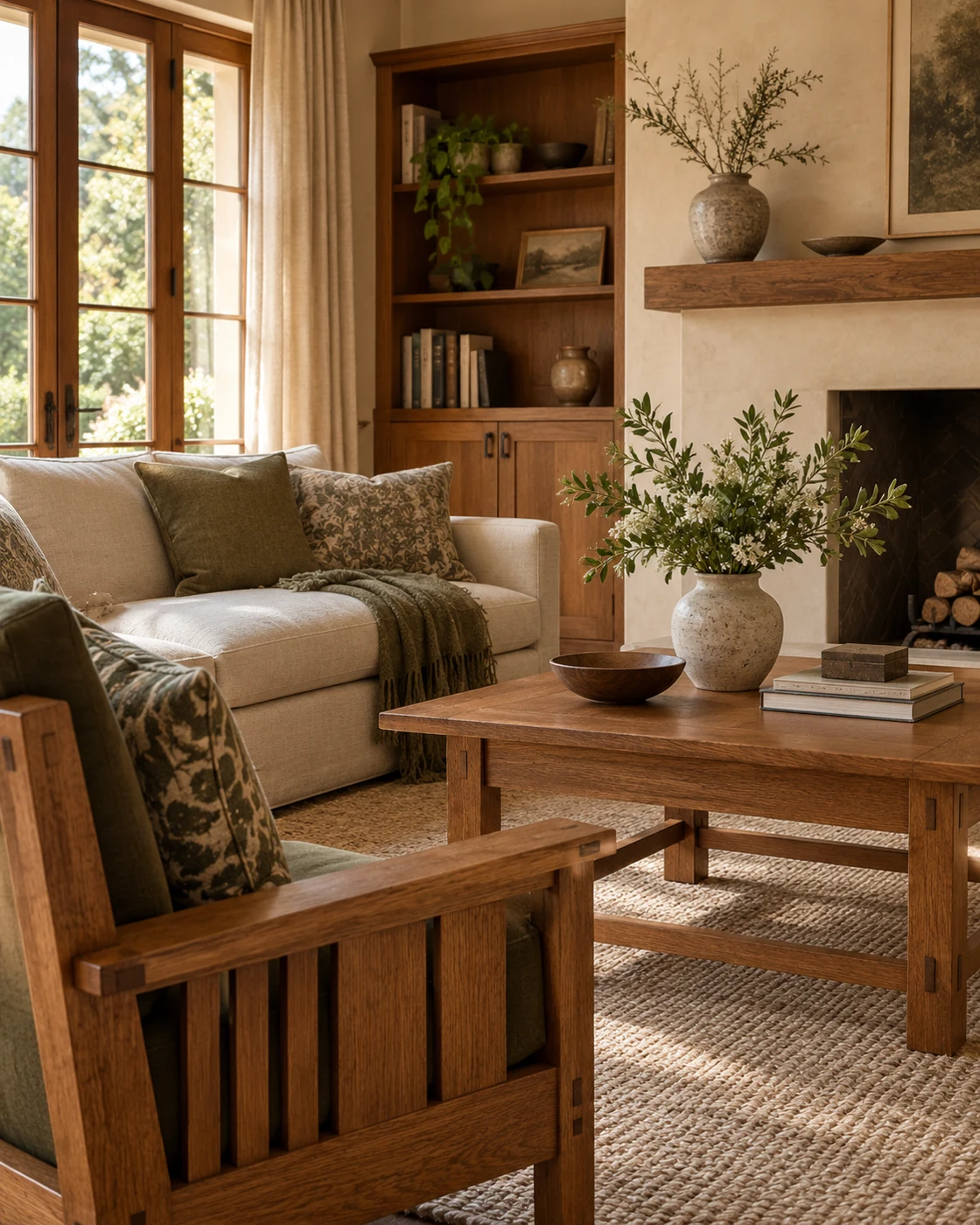
Some homes are tidy, bright and tastefully furnished, yet still seem to lack a voice. Every element is right, but the quiet connection between the resident and their surroundings is missing. Adding accessories seldom solves the problem: it may simply multiply the things demanding attention. Arts and Crafts offers a different path, grounded in use, material and the care of making. It requires neither an English country house nor a major purchase at every step. It asks more precise questions: why is this object here, how is it constructed, and what relationship does it create with the others and with everyday life?
A movement before a style
Emerging in Britain in the second half of the nineteenth century, Arts and Crafts placed craft and the relationship between designing and making at its centre. William Morris was an influential figure; Philip Webb designed Red House, built in 1859. As the Victoria and Albert Museum explains, the movement encompassed varied ideals and practices rather than a single decorative formula. Its history also concerns production conditions, not simply floral patterns and wooden furniture.
Applying these principles today is a contemporary design choice rather than a historical reconstruction. We can appreciate a legible joint or a surface that ages well without rejecting every industrial process. The useful distinction is between a detail that serves the project and an effect applied merely to suggest authenticity.
Begin with what you already own
Before seeking new furniture, observe the room in the morning and evening. Note where you sit, put down a book and encounter objects that make a simple action awkward. Then choose something you want to keep: a family sideboard, a table, a lamp or a ceramic piece. Its value need not be financial. It should become a recognisable presence rather than disappear among many small decorations.
Temporarily clear the nearby surface and try a position visible from the entrance. Assess the result without buying anything. A dark cabinet may need a quieter wall; a small object may need a less crowded shelf. Photographing two alternatives from the same viewpoint helps compare proportions and bulk. This step prevents the search for character from becoming a series of disconnected purchases.
Material and construction: questions worth asking
With timber, examine edges, joints and the continuity of surfaces. Ask which parts are solid wood and which are veneered, how the finish is treated and whether repairs or refinishing are possible. Veneer is not automatically a flaw: understanding the actual construction and choosing for the intended use matters. A table where a family eats and works needs maintenance compatible with that daily life.
With metal, proportions and connections affect visual quality as much as colour. A slender handle can support a light cabinet; a heavy support may dominate it. For ceramics and textiles, ask about cleaning, intended use and resistance where relevant. An irregular surface does not necessarily mean better craftsmanship. Care also reveals itself through function: stability, comfortable edges and details that are easy to maintain.
A whole room, rather than a collection
An important Arts and Crafts principle was the relationship between architecture, furnishings and decoration. In a contemporary living room this means considering flooring, doors, furniture and textiles together. Choose a guiding material and let the others support it. If oak is already present in the floor, a sideboard need not copy its colour: it may relate through a similar tone or a deliberate contrast tested with actual samples.
In a compact room, concentrating character in one cabinet and one textile leaves more breathing space. In a large room, repeating a finish at separate points can create continuity without mechanical distribution. Check circulation against the plan and furniture in use, including open doors and chairs pulled out. A coherent interior must accommodate people moving through it, rather than only work in photographs.
Botanical patterns without overload
Ornament can bring nature and rhythm into a room. For a measured interpretation, first decide where the pattern should lead: a textile, a wall or a panel. Keep adjacent surfaces quieter so the pattern stays legible. Muted green beside timber and pale plaster can create an intimate atmosphere; this is a compositional possibility, not a compulsory historical rule.
Test a sample in its intended position, both close up and from the entrance. A pattern that appeals on screen may look too dense at a distance or compete with a full bookcase. With a modest budget, begin with a removable element such as a cover or fabric already available. Avoid repeating one pattern on curtains, cushions and walls merely to identify a style: colour and scale can also establish coherence.
Light that reveals the making
Carefully worked material loses presence when light flattens it. Observe how lateral light reveals grain, weave or ceramics: every object does not need a spotlight. Diffuse light for moving around and local light for reading may be enough to create depth. Position lamps with eye level and reflections in mind, particularly near glass, glossy glazes and metal.
Before fixing new lighting points, test an available lamp in two positions. Check whether the detail you want to highlight remains visible without dazzling someone seated nearby. When several sources share the same visual field, consider consistent colour rendering and colour temperature. Light serves the person and the activity first, then the presentation. A beautiful corner that is uncomfortable for reading is an incomplete result.
Invest thoughtfully, even slowly
Define a tangible priority: improving the table used daily, recovering a cabinet or introducing one meaningful crafted detail. Compare complete costs including delivery, assembly, adaptations and maintenance. A recovered piece may be worthwhile, but inspect stability and condition before budgeting restoration. Do not automatically assign sustainability to every craft purchase: origin, longevity, treatments and actual use all matter.
Allocate the budget according to what you touch and use most often. If bespoke work exceeds the available amount, reduce the number of elements, simplify the geometry or retain existing furniture and improve its surroundings. Request a quotation with identifiable materials, finishes and operations. Beauty does not depend on the quantity of special pieces: one well-chosen element can give the entire room direction.
A practical trial: a living room without identity
Imagine a living room with a neutral sofa, a pale floor and many small accessories. First remove what you do not use and retain three meaningful presences. Then select a focal point, perhaps a sideboard, and give its silhouette room. Introduce a botanical textile accent in proportion to the seating and useful reading light. Finally check that the remaining objects say something about you rather than reproduce an image seen elsewhere.
This is a proposed method, not a completed project or a universal recipe. Test it with what you own and assess the room during a week of use. Common mistakes include buying everything at once, treating “handmade” as an absolute guarantee and accumulating historical details without considering context. Character emerges when choices relate to one another and to the person living there.
Sources and further reading
A home that recognises its residents
Arts and Crafts can invite us to choose more carefully and give objects time. White Diamond can help translate this sensitivity into a coherent project shaped around your spaces, habits and budget, beginning with what you want to keep and what you want to feel at home.
Let’s discuss your project