
Lighting above the dining table: height, proportion and glare-free comfort
The right pendant is more than a beautiful object: it gathers people, lights what happens on the table and lets the room breathe.
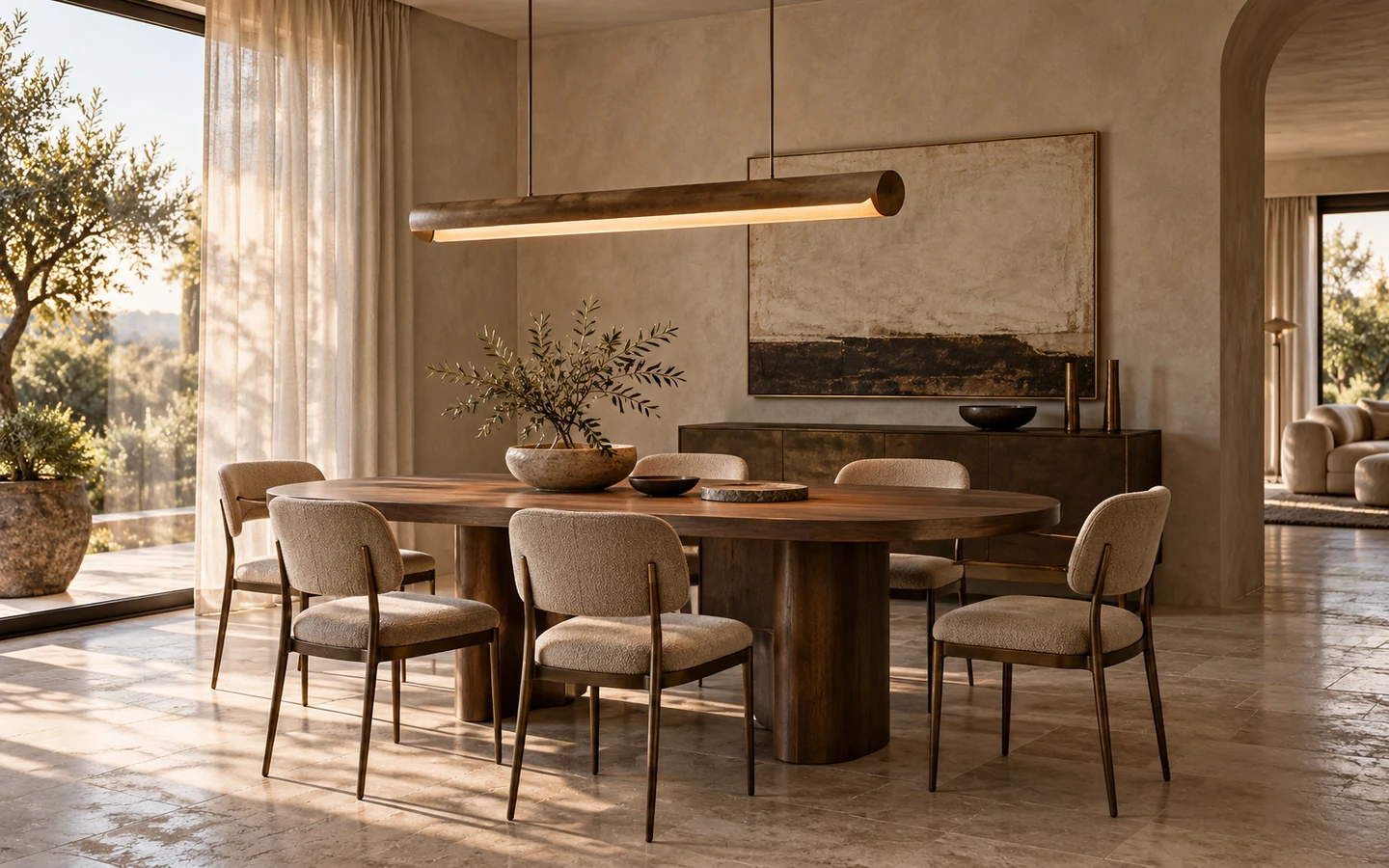
The table is chosen and the chairs work, yet the light always seems misplaced: too high and it loses focus, too low and it becomes an obstacle, too small and it disappears inside the room. This happens because a pendant is often bought as an isolated object. In practice it must connect four elements: tabletop, people, ceiling and surrounding light. Position, proportion and light quality therefore come before the model. When those decisions are coherent, even a simple form gains presence and the table becomes the natural centre of the home.
Start from the real centre, not the centre of the room
Centre the light over the table in its everyday position, not automatically over the whole ceiling. In an open-plan room the table may be offset to preserve circulation or relate to the kitchen. Mark its final footprint and project the centre upwards, then check the electrical outlet. When an existing rose is misplaced, an intentional offset cable or track can look better than a hesitant correction. Test the extended table too: its centre may move, and the main seats should remain properly served.
Height is a relationship, not an absolute number
As a first mock-up, many arrangements work with the lower edge roughly 60–80 centimetres above the tabletop, but this is not a universal rule. A wide opaque shade may hang lower; a bright or transparent source may need greater distance. Sit in every chair: you should see the person opposite without the fitting cutting across the view or presenting a glaring point. Check the standing view and the approach from the doorway as well. The correct height comes from ceiling height, fitting size, beam spread and the people using the table.
Match the geometry without copying it
Rectangular and oval tables suit linear pendants, a sequence of two or three fittings, or an elongated volume. A round table is often strengthened by a central form or compact cluster. The shapes need not match exactly; they need a clear hierarchy. Keep the fitting visually within the tabletop area and its ends away from heads. For an extending table, design around the most frequent arrangement and make sure the end seats still receive useful light when it opens. Adjustable or multipoint systems can offer extra flexibility.
Scale: neither a lost jewel nor a luminous roof
A tiny pendant above a substantial table feels accidental; an oversized mass can compress the diners and compete with the architecture. Judge perceived width, not dimensions alone: transparent glass, an open metal frame and a solid diffuser occupy space differently. Make a cardboard or tape outline, hang it temporarily and view it from the kitchen, living area and entrance. Include the table thickness, centrepiece and chair backs. The empty space around the light is part of the composition, allowing fitting, table and walls to read together.
Light the table, not the eyes
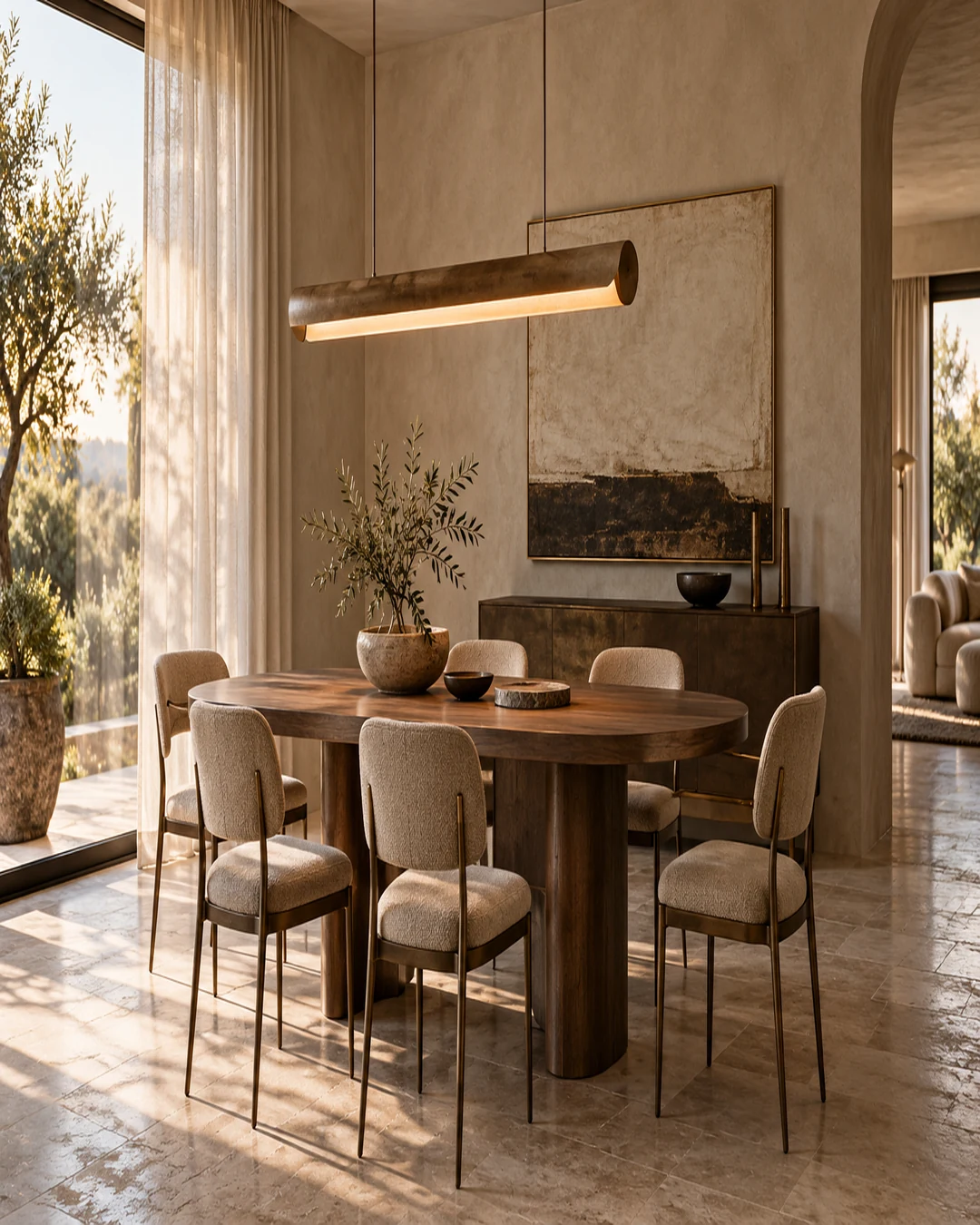
Useful light should reach plates, hands and objects evenly while the source stays shielded from normal viewing directions. CIE guidance notes that comfort depends not only on quantity but also on distribution, colour characteristics, surfaces and glare. Opal diffusers, recessed optics and indirect components soften aggressive contrast. Glossy tables, glass and polished stone can mirror the source, so test the fitting or simulate its position before purchase. Dimming a powerful lamp cannot correct a badly placed visible source; control and shielding must be designed together.
Warmth, colour and the atmosphere of a meal
Warm light supports natural materials and conversation, but a nominal colour temperature does not tell the whole story. Observe how the source renders timber, fabric, skin tones and food, using real samples at night. Avoid mixing dramatically different colour temperatures in one view without a deliberate reason, as the dining zone may appear unintentionally detached. Dark walls and coloured ceilings also absorb more light than pale surfaces. The goal is not total uniformity but a gentle presence at the table with legible circulation around it.
Separate controls for different moments
Dinner, homework, work and clearing up need different levels. A compatible dimmer helps adapt intensity when lamp, driver and control are selected as one system. Where possible, separate the pendant from general and accent lighting so the table can glow without flattening the whole room. During electrical planning, decide where it should be switched and keep drivers accessible. If the table moves frequently, a lighting track or prepared outlets may avoid extensions and later building work. Electrical changes should always be carried out and checked by a qualified professional.
Common mistakes and a full-size test
Frequent mistakes include centring on the room rather than the table, choosing from a catalogue photograph alone, ignoring reflections and fixing the rose before the furniture plan. Avoid pendants spaced so widely that they create isolated pools, and decorative fittings that provide no useful table light. For a simple test, hang a full-size outline at the proposed height and place a temporary shielded light over the surface. Sit down, stand up, set the table and look from every entrance. A ten-minute mock-up reveals problems that a specification sheet cannot.
Budget and decision order
Separate the budget into fitting, lamp or LED module, dimmer, offset hardware, installation and ceiling repair. An expensive fitting in the wrong position remains an expensive mistake; a simpler, well-positioned and shielded solution can feel more refined. Confirm the table first, then chairs and circulation, choose the lighting family, establish height and electrical point, and only then order finishes and accessories. Keep technical sheets and instructions: control compatibility, maintenance and source replaceability all influence long-term quality.
Technical references
Institutional websites and industry documentation consulted on 7 October 2026.
Light the ritual, not only the furniture
White Diamond can plan your dining area from real measurements, coordinating table, chairs, pendant, electrical points and surrounding light. Plans, views and personalised renders let you compare height, proportion and atmosphere before purchase and installation, avoiding corrections to a finished ceiling.
Request your personalised quote