Where should a rain barrel go in a small garden?
A 68 cm wheelbarrow settles the choice between two spots beside the same downspout. A watering can tells you whether the tap will be easy to use.
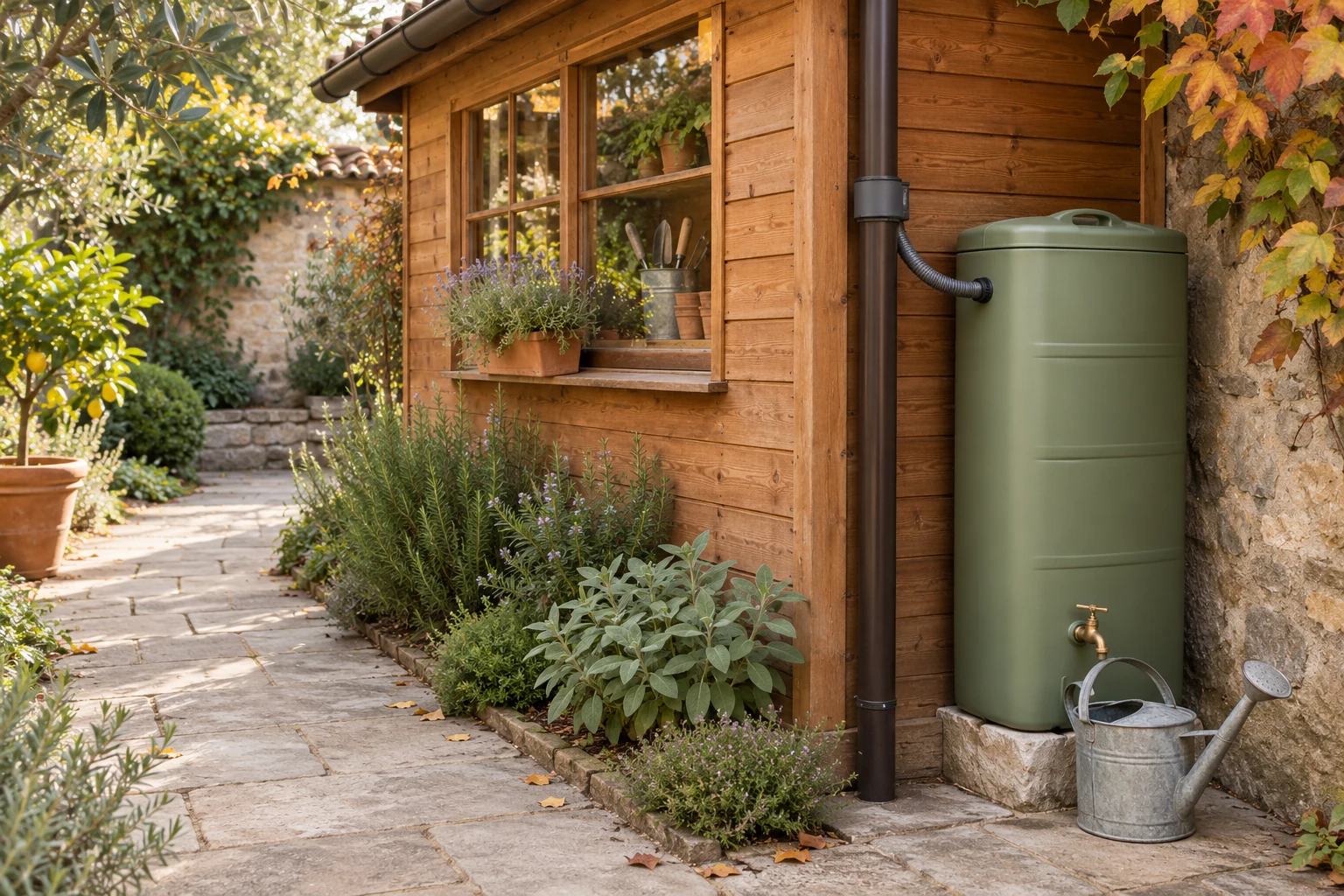
There is a stretch of path between the shed wall and the planting bed where a rain barrel fits perfectly. The wheelbarrow fits too, as long as you try it on its own. Before deciding where to collect water, take the wheelbarrow and watering can you actually use out into the garden.
Try the wheelbarrow first
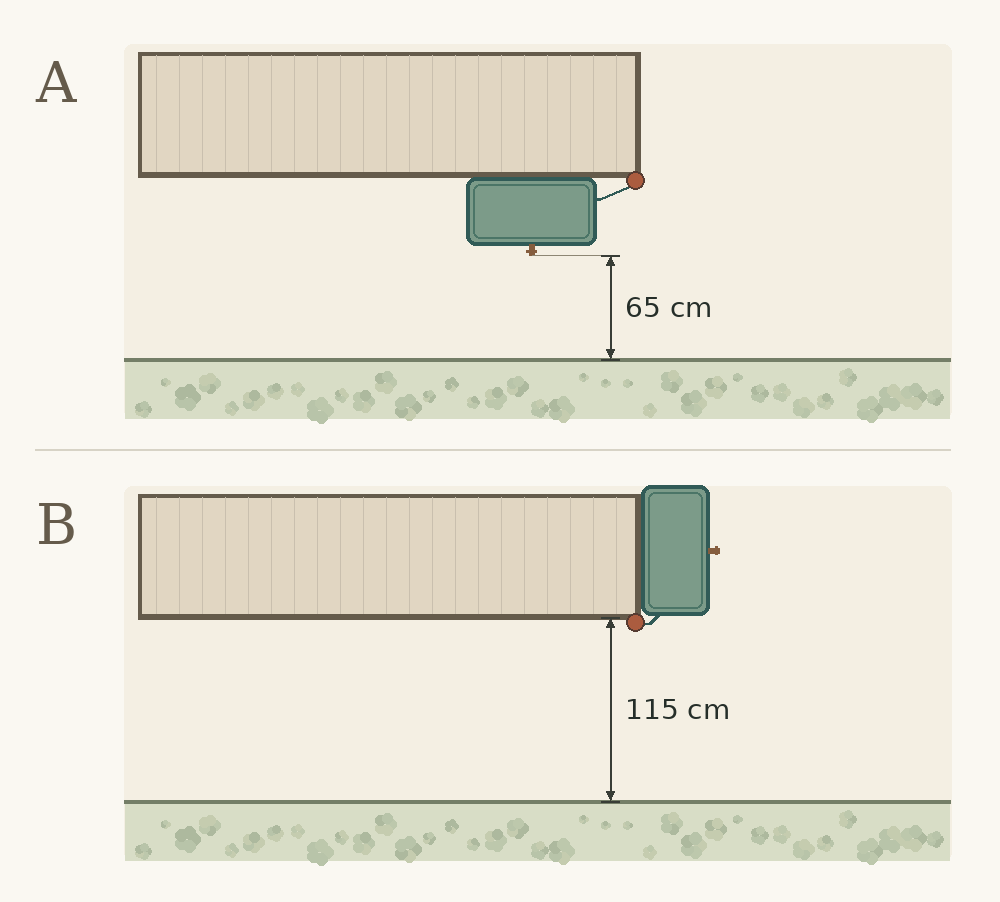
Imagine a path 115 cm wide. In position A the barrel stands along the shed’s long wall, beside the downspout at the corner. Measured to the tip of the tap, it projects 50 cm into the path. That leaves 65 cm. A wheelbarrow measuring 68 cm across its tray is just three centimetres too wide to get through.
In position B the same barrel goes around the corner onto the end wall, in a service area you can reach from the garden. The path keeps its full 115 cm. I would choose B here, after checking that the manufacturer’s diverter connection will reach from the downspout. These dimensions belong to this example. For your own garden, measure the narrowest point and the widest thing you need to move through it.
Fill and lift your own watering can
Mark the full footprint on the ground, including the tap. Use a box to stand in for the barrel and mark the intended tap height on it. Slide your watering can underneath. Water should drop into the opening, with room for your hand on the handle. Now go through the motion of lifting a full can and turning towards the pots. If you have to step into the bed or knock the handle against the wall, try facing the tap another way or choose a different spot.
Check that you can lift the lid and reach the filter. The Royal Horticultural Society recommends a firm, level base and enough height to fit a watering can under the tap. If you want to hide the barrel behind a trellis, leave enough room to do all of this.
How much water reaches this downspout?
Suppose the whole shed roof drains into one downspout. A roof measuring 3 × 4 m in plan has a catchment of 12 m². An 8 mm shower puts a theoretical 96 litres on that roof. One millimetre of rain on one square metre is one litre. The ISEA technical manual from Aliaxis uses the horizontal footprint and distinguishes rain falling on the roof from water collected. How much runs off depends partly on the roof covering.
If a 100-litre barrel already holds 40 litres, it has room for at most 60 more. Before fixing its position, trace the route water will take once the barrel is full. Some diverters let excess water continue down the original downspout. Other arrangements need a suitable outlet for an overflow. Keep the discharge off the path and away from the shed wall.
Mark the full footprint, the part of the path that needs to stay clear and the overflow destination on the plan. Those three marks give you and your garden designer a precise choice to discuss.