
Living room curtains: protect your privacy, welcome the light
The window is where your home meets the world. Carefully chosen curtains decide how much to welcome in, while giving the room space to breathe.
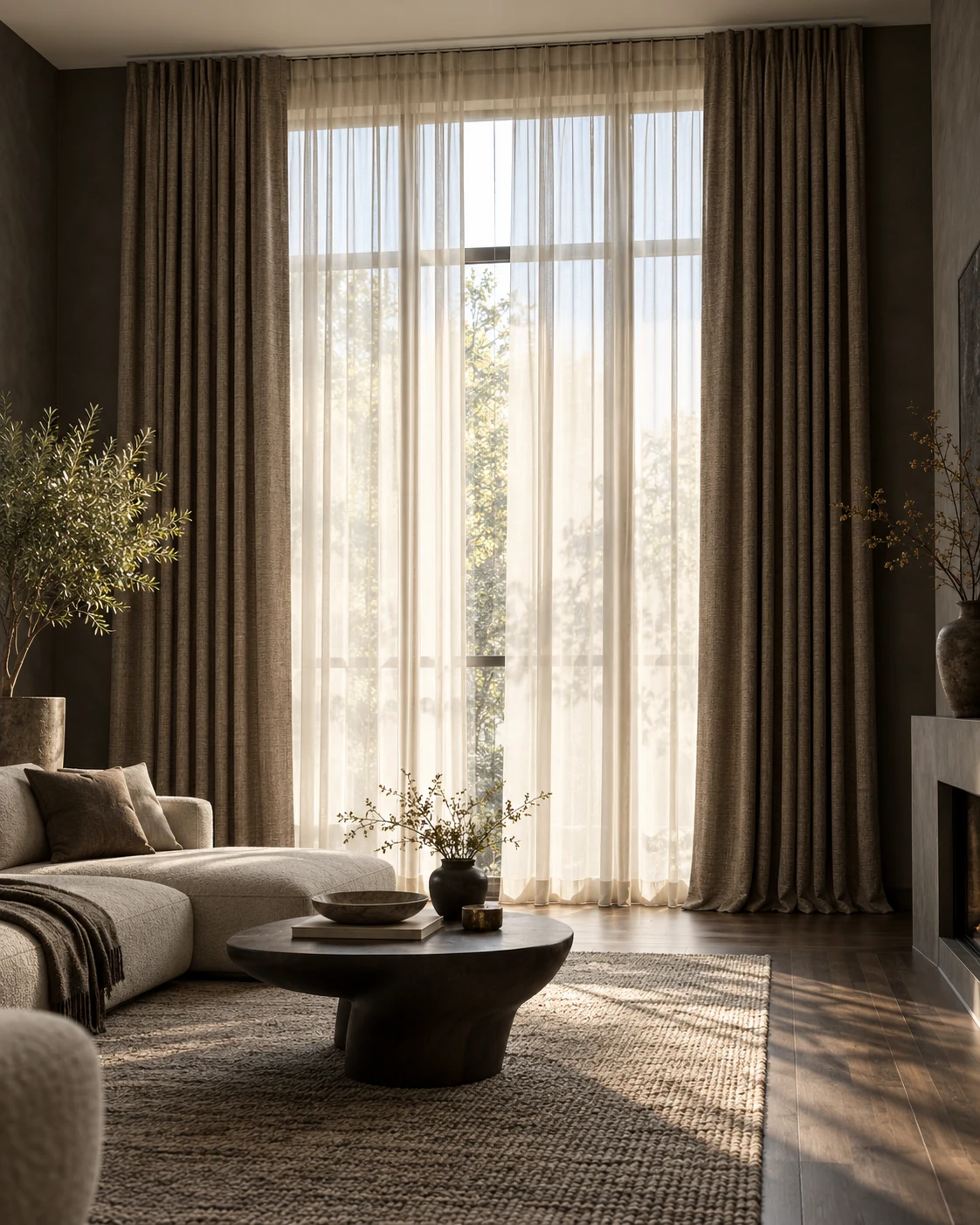
You have chosen the sofa, settled on a wall colour and positioned the lamps. Yet the living room still feels unfinished around the window. Daylight is pleasant, but you feel exposed; after dark, with the lights on, the glass becomes a display window. A very heavy curtain solves part of the problem and creates another: the room loses brightness even when you want it. The right choice begins with how you use the space, rather than the colour of the fabric.
Observe the window before choosing the curtains
Spend a day noticing what happens around the glass. Look at the room in the morning, afternoon and after sunset: where do overlooking views come from, when does sunlight hit the television, and which areas remain in shadow? A window facing a private garden calls for a different response from a ground-floor window facing the street. If screen glare is the only problem, shading at particular times may be enough. Evening privacy requires a genuinely opaque closure.
Rank three priorities: daylight, privacy and darkness. Add practical obstacles such as radiators, handles, shutter boxes and doors that need to open. This small assessment prevents you from buying beautiful fabric that cannot move freely or has to stay closed. To coordinate curtains with your lamps, explore our guide to living room lighting as well.
Sheer, opaque or two layers?
A sheer diffuses light and softens direct views, but does not guarantee privacy in every condition. When the interior is brighter than outdoors, silhouettes and details may remain visible. Test it from both sides of the window, especially after dark. An opaque fabric offers greater protection from overlooking; blackout fabric is designed to restrict light passing through the cloth, but gaps at the sides and above the track can still admit it.
Two layers separate these tasks. A lightweight curtain stays drawn during the day; a denser layer closes when you want greater intimacy. This need not look theatrical: ivory sheers and taupe curtains with regular folds can complement a dark wall without making it feel heavy. In a room already short of daylight, start with the sheer and add blackout only where useful, rather than making every window opaque.
Proportions that make the room feel more composed
A curtain reads as an architectural surface. A high fixing point can lead the eye towards the ceiling and reduce visual breaks between the window and wall. That does not mean it should always cover the entire wall. With substantial mouldings or a very high ceiling, consider the overall balance. A discreet track works well in a restrained interior; an exposed pole can echo metallic lamp finishes.
Allow room at the sides for the gathered fabric when open: folds sitting in front of the glass reduce daylight precisely when you want to recover it. A curtain just touching the floor creates continuity; a small clearance makes cleaning easier. Generous pooling is a more demanding choice, particularly with pets, children or busy walkways. Test the height with a temporary cloth before committing to the final hems.
Measure carefully instead of relying on one universal formula
Measure the width of the curtain system, rather than only the window. Gathered curtains need more fabric than the track width: the ratio depends on heading tape, pleat style and material. As a design example, a 200 cm track with 2:1 fullness requires approximately 400 cm of fabric overall before tailoring adjustments. Confirm the ratio with the curtain maker. Sliding panels use a different calculation, including overlaps and stacking space.
Measure the height at several points from the actual hanging reference to the floor. Check the depth needed to clear handles and the sill. Two layers require enough separation for both curtains to move without dragging each other. Photographing these details and adding measurements to a sketch is more useful than choosing a colour immediately from a small online image.
Fabric and colour: elegance must work every day
Linen has a tactile character and naturally relaxed folds; blends and synthetic fabrics may offer a more regular appearance or different care requirements. No fibre is automatically best. View a sample against the light, read composition and washing instructions, and check any dimensional changes specified by the manufacturer. A colour name is not enough: warm grey beside a pink-toned floor may look different from its appearance on a screen.
Repeat a shade already present in the room, but vary the texture slightly: matte fabric can balance a glossy cabinet, and a subtle weave can add depth to plain walls. Avoid adding prominent patterns when the rug and sofa already command attention. Include making, supports and installation in your budget. Spending everything on the cloth while compromising on the track makes an everyday element inconvenient to use.
Three situations, three different responses
In a ground-floor living room, a sheer can accompany daylight and an opaque curtain can protect the evening. If circulation space is tight, consider frosted film on the portion of glass exposed to overlooking. It frees space, but changes the view even when you would prefer it completely open. For a large glazed opening in a minimal interior, sliding panels create sharper surfaces than folds, provided there is room for them to stack.
If you often watch films in the room, blackout can be a useful second function. Before choosing a fabric advertised as thermal, however, consider the whole window and ventilation. Do not expect curtains to correct every heat loss or overheating issue. Avoid covering radiators and vents without assessing how the system works. Good design depends on compatible details rather than accumulating accessories.
Mistakes to avoid before ordering
Do not choose length from a standard height alone, confuse one panel with a pair, or assume a track includes fabric. Check load capacity, fixing points and the wall or ceiling substrate with an installer. Finally, test evening closure: this is when apparently perfect curtains often reveal their limitations. A measured choice lets you retain daylight while enjoying the feeling of being at home.
The White Diamond selection
These three options address different needs: panel movement, a textile presence and localised privacy on glass. They do not automatically form a system to buy together. Identify the window’s problem first and choose a compatible solution: size, installation and coverage matter as much as colour.
Products to considerThree options for different needs, to consider as alternatives or parts of a design. They are not a kit and are not necessarily compatible with each other. Listings and models were checked on 29 September 2026; confirm the variant, package contents and availability before buying. Links lead to Amazon Italy.
TENDAGGIMANIA five-track panel curtain rail, 280 cm
A white aluminium system for sliding panel curtains, worth considering when you want clean lines across a large glazed opening. Five tracks organise panel movement; assess stacking space and the mounting method. This selection concerns the rail: check fabric, accessories and configuration separately. Measure before ordering. It can create composed surfaces instead of traditional gathered drapery.
View the Amazon listingMoondream ThermActiv 2in1, 140 × 180 cm, red MC330
MC330 red can become the living room’s textile focal point: test it beside warm walls and restrained furniture, both in daylight and under lamps. The 140 × 180 cm size requires careful measuring; it will not automatically suit a full-height glazed door or ceiling installation. Check its heading and technical details. A distinctive curtain works best when other fabrics give it room instead of competing with it.
View the Amazon listingrabbitgoo static frosted window film, 44.5 × 200 cm
A complementary solution when overlooking mainly affects the lower window and a curtain would take up too much space. The opaque white variant adheres statically to smooth glass using water, without glue. It can leave the upper glass clear while reducing visibility through the treated area, although you lose a sharp view through that portion. Check glass and film compatibility and instructions, measure each pane and plan any joins. It is not a blackout system for watching films.
View the Amazon listingAdvertisement · Product links are Amazon affiliate links. As an Amazon Associate I earn from qualifying purchases. Prices and availability may change.
Manufacturer and seller listings checked on 29 September 2026.
Advertisement · As an Amazon Associate I earn from qualifying purchases. Check the variant, dimensions and terms in the seller’s listing.
Light that belongs to your home.
Curtains need not hide the room. They can help it find a rhythm between openness and retreat. To consider fabrics, proportions and lighting together, tell me how you use your living room. A White Diamond consultation, available online too, begins with your needs and real measurements.
Let's discuss your living room