
Lighting a garden path: see the steps, not the fittings
A well-lit outdoor route should not resemble a runway. It guides quietly, reveals changes of level and allows the night to retain its depth.
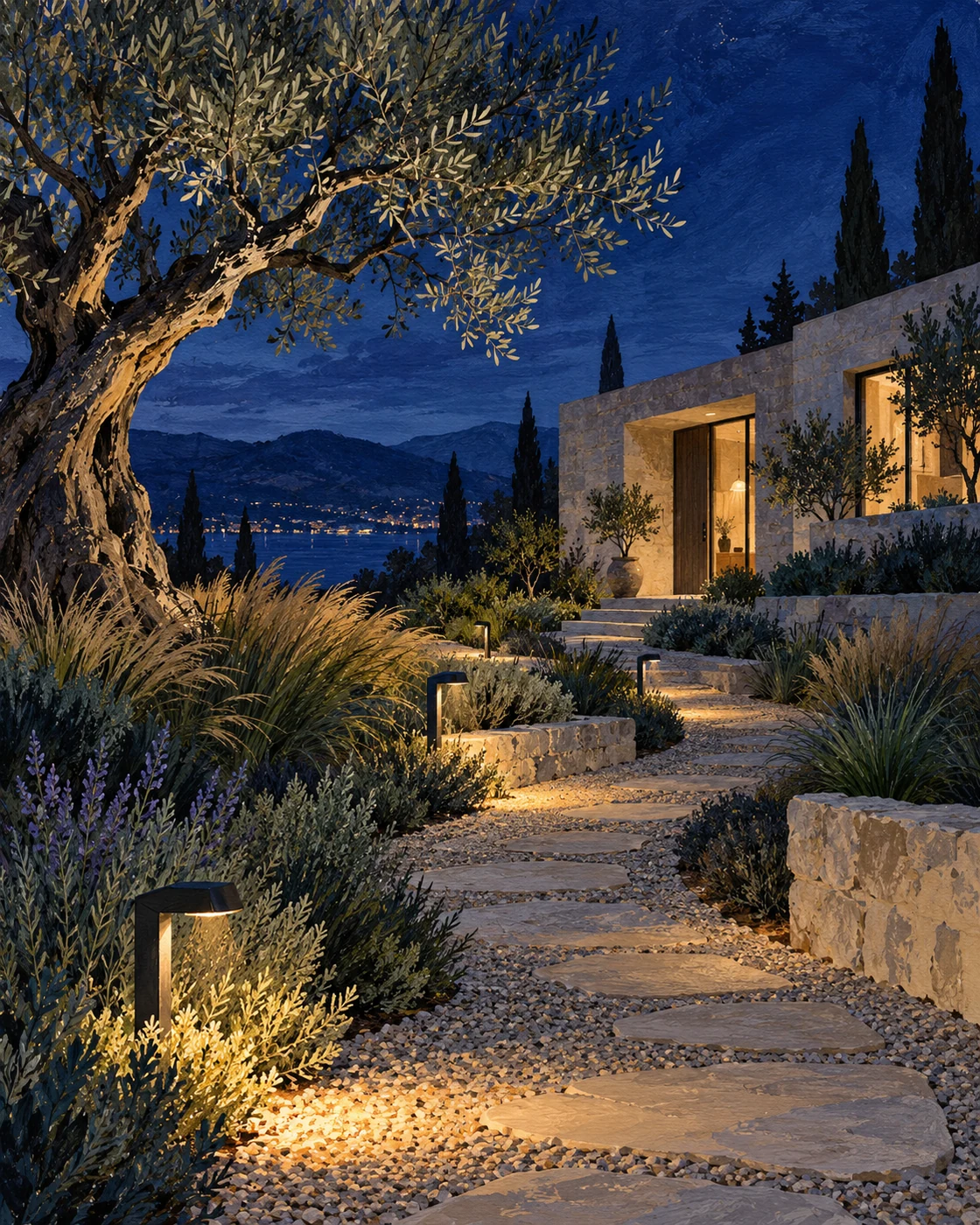
When a garden path feels dark, the instinct is to add brighter lamps. The result is often a flat garden: visible points, hard shadows, glaring lenses and a row of bollards competing with planting. Safety comes from continuity of information rather than sheer quantity. You need to recognise the next footfall, understand a bend, see a step and perceive the destination. Good design lights surfaces and thresholds, not the eyes of the person walking. Observe the route first; choose fittings afterwards.
Map the route before choosing a lamp
Walk from gate to door after dark and record bends, steps, material changes, low branches and the point where keys or intercom are used. Divide the journey into functional light for hazards, orientation light on a wall or tree, and a softer welcome at the entrance. Equal intensity everywhere guides nowhere; a clear hierarchy uses fewer fittings and creates depth.
Hide the source and let the surface speak
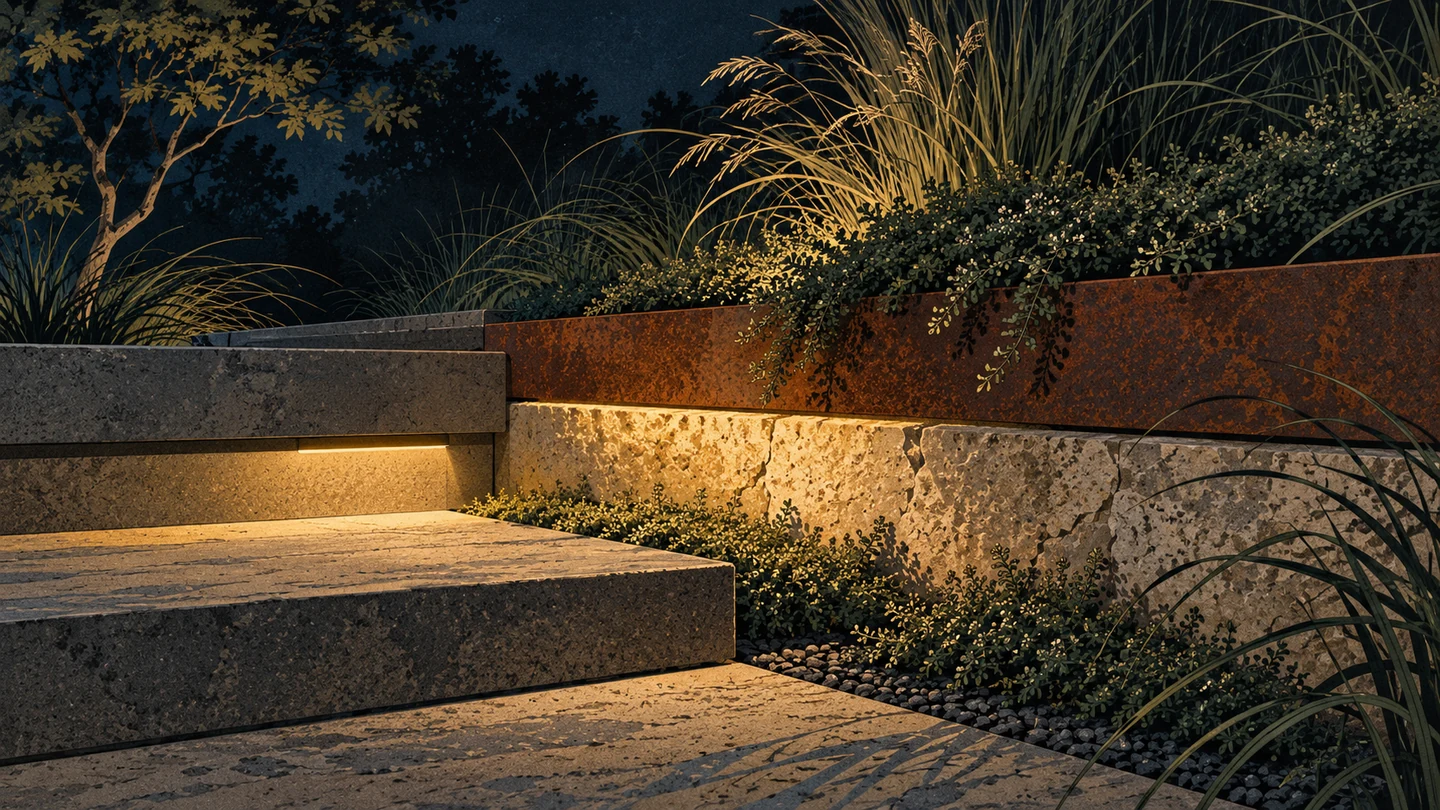
Comfort improves when the LED is not directly visible. Choose shielded downward bollards, side-mounted step lights or adjustable spots whose beam ends on a surface. Check the view from windows and gate too. Uplights can reveal one selected tree or wall, but should not become a row aimed at the sky. Grazing light describes texture and edges; frontal light removes the small shadows that make level changes readable.
Test spacing at night
There is no universal interval. Height, beam angle, paving reflectance and planting change the result. Pale limestone returns more light than dark porphyry; grasses cast moving shadows. Test temporary sources from both directions before fixing positions. Avoid runway symmetry: alternating sides can create rhythm, while regular step lighting makes the sequence predictable. Continuity means no sudden loss of information, not uniform brightness.
Colour temperature and materials shape perception
Warm light around 2700–3000 K, where available, works naturally with stone, timber, weathering steel and Mediterranean planting. Mixing several whites can look accidental. Keep colour effects for occasional scenes, not daily guidance. Finish matters by day: anthracite recedes among plants, while polished steel and white diffusers remain conspicuous. Judge the fitting in daylight as well as after dark.
Electrical safety is part of the design
Protection ratings, supply, connectors and installation must suit the precise location. IP44, IP65 and IP67 describe different protection levels; check the individual model against rain, jets, pooling water and mounting conditions. A weather-resistant fitting does not make an improvised joint safe. Mains circuits and permanent work require a qualified professional. Low-voltage systems still need compatible transformers, correct load, approved connections, protected cables, drainage and maintenance access.
Three expensive mistakes
Buying before mapping the route produces mismatched fittings while the critical step remains dark. Lighting every plant destroys hierarchy and multiplies wiring, energy and maintenance. Relying only on sensors or an app turns convenience into fragility: the main route should remain understandable when a connection fails. Schedule dimming or switch-off when it is unused. Night is part of the garden, not a background to erase.
Objects selected for the project
Four different roles: a guiding bollard, an adjustable accent spot, a low-voltage kit and a portable arrival light. They are not a compulsory set. Choose the type that solves your route, then verify variant, components, installation and availability on Amazon.it.
Philips Splay 12 W pathway pedestal
Philips identifies model 8719514417779 as a 12 W outdoor pedestal and lists IP44. Its broad head and anthracite finish suit pale stone and structured planting, but daytime height and sightlines need testing. It is a fixed solution, so supply, base and connections require proper design and installation.
Find the model on Amazon.itPhilips Hue Lily 1742830P7 outdoor spot
Lily establishes a lateral landmark — a canopy, wall or house number — rather than marking every footfall alone. Philips Hue lists IP65, 600 lumens and low-voltage technology. Adjustment lets the beam finish on a surface and helps control glare. Colour is optional, not a reason to saturate the garden nightly. Check which power components the selected version includes.
Find the model on Amazon.itPaulmann Plug & Shine Pike Basic Set 94242
Paulmann lists three stake spots, 3000 K, a 24 V system, IP65 and 3 × 2.2 W. It is useful for a reversible test along beds and edges, allowing direction and spacing to be corrected before the scheme is stabilised. Stakes do not suit every soil or circulation zone, and transformer capacity matters. Use them for selected accents rather than every plant.
Find the model on Amazon.itZafferano Poldina Pro IP65
Poldina Pro does not replace a step light; it completes the destination. On a table near the door or beneath a porch it provides rechargeable, dimmable and movable light. The official specification lists IP65 and selectable 2200, 2700 and 3000 K settings. Its iconic silhouette introduces a genuine design object where people pause. Recharge and use it as instructed; do not make it responsible for permanent path safety.
Find the model on Amazon.itAdvertisement · Product links are Amazon affiliate links. As an Amazon Associate I earn from qualifying purchases. Prices and availability may change.
Sources and specifications
Official specifications and Amazon.it links consulted on 3 October 2026. The Amazon link opens a model search: check seller, variant, components and availability before buying.
Make the route legible before decorating the night
White Diamond can turn your outdoor plan into a coordinated lighting scheme: hierarchy, positions, beam direction, relationships with planting and materials, plus night renders to compare atmosphere before installation. Design defines the effect; electrical verification and installation remain the work of qualified professionals.
Request your personalised quote