What beam angle works for reading in bed?
The middle of the book looks bright, but the last word on each line slips into shadow. Two measurements taken from your pillow can help you choose a reading spot.
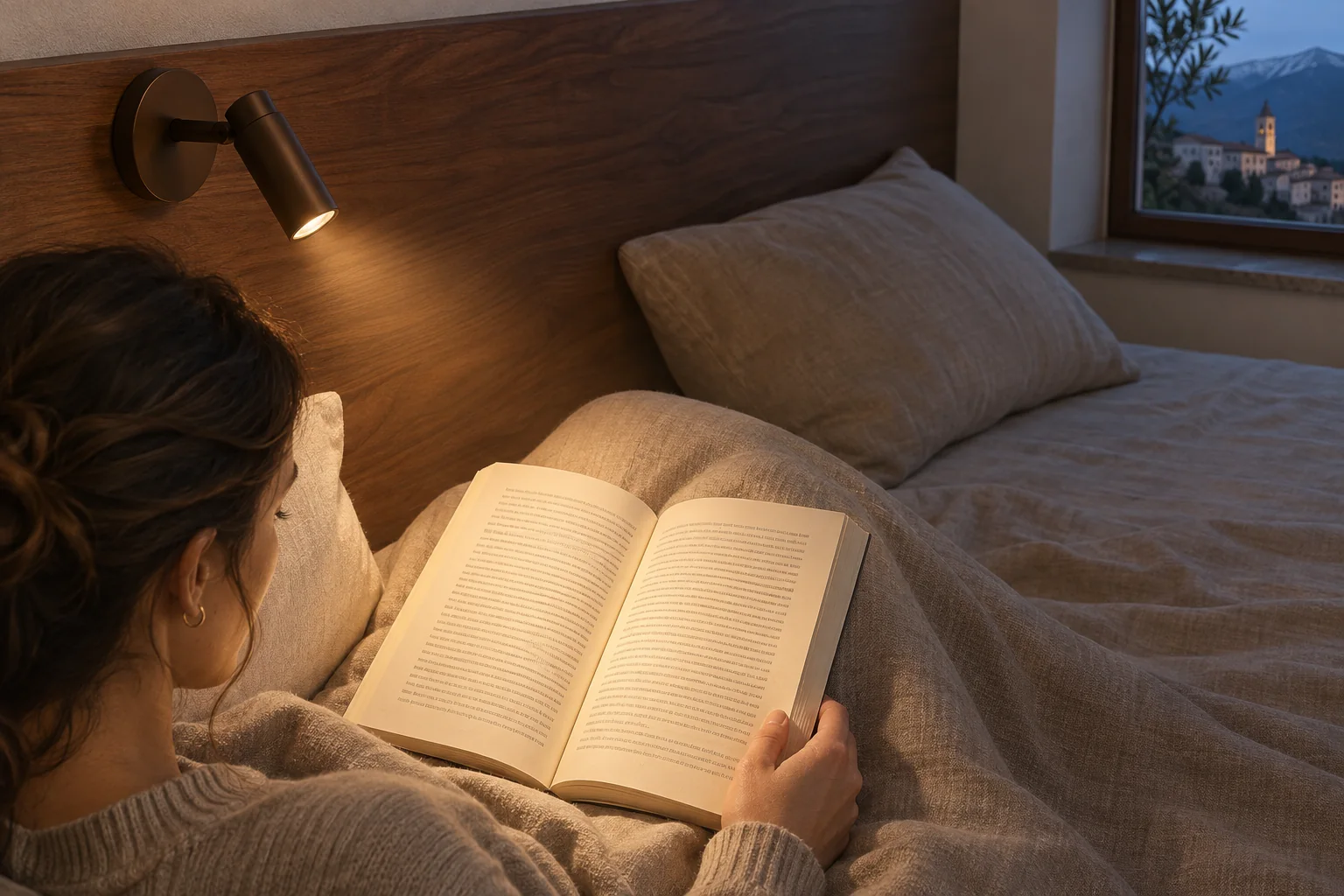
Follow a line from the binding to the outer edge of the page. If you have to move the book into the light to read the last few words, turning up the brightness may just make the already bright patch brighter. Before changing the lamp, check how much space the open book actually takes up.
Measure from the lens to the book
Sit back against your pillows and open a book the way you normally hold it. Measure the two pages together, across and from top to bottom. Then measure from the lens of the reading spot to the center of the book, along the direction of the beam. If you are still deciding where to install the fixture, have someone hold the end of a tape measure there while you read. Headboard height alone tells you little about how much of the page the beam will cover.
The same lumens can give a different spread
Philips lists 24° and 36° versions of its MASTER LEDspot ExpertColor MR16 930. Both deliver 480 lumens at 3000 K. The narrow optic concentrates more light along its axis. Its listed intensity is 2400 candelas, compared with 1450 for the wider optic. Two boxes with the same lumen rating can give quite different pools of light.
For a symmetrical beam, the ERCO glossary gives the angle between the two directions where intensity drops to half the central value. Light continues beyond that outline. The angle helps predict coverage. To judge how evenly the pages are lit, try the lamp with your own book.
An open book at seventy centimeters
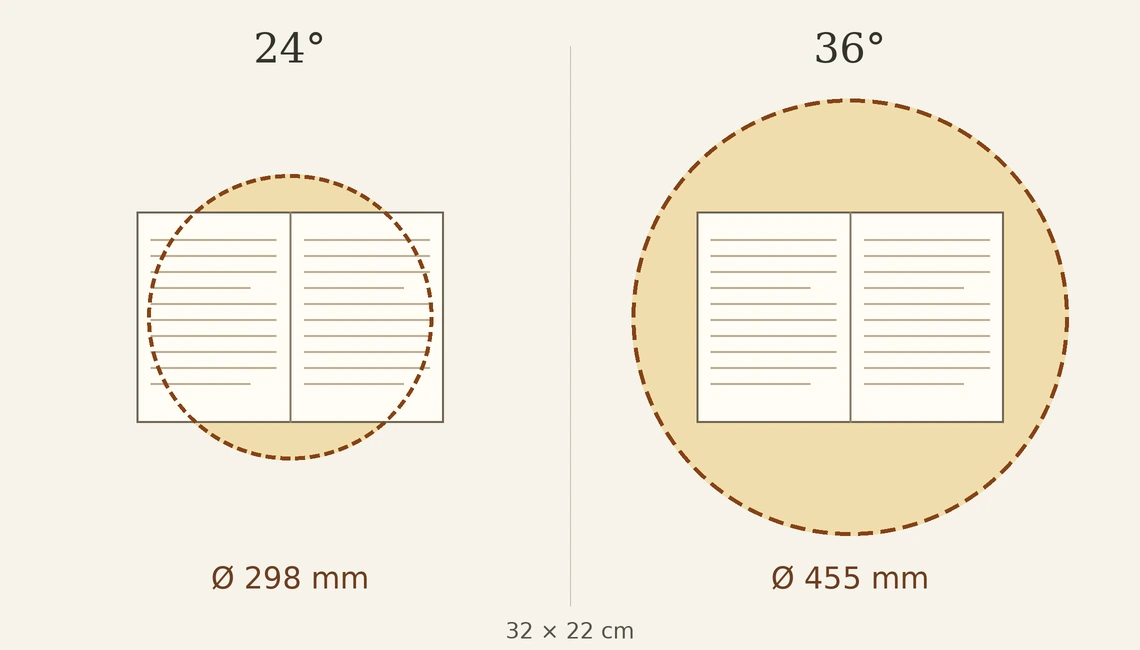
Suppose your book measures 32 × 22 cm when open, with both pages flat and the lens 70 cm from the center. Aim straight at the fold, at right angles to the spread. To estimate the beam diameter, double the distance and multiply by the tangent of half the beam angle. At 24° the diameter is about 29.8 cm, narrower than the book itself. At 36° it grows to 45.5 cm, enough to enclose all four corners. The diagonal of the spread is about 38.8 cm.
Bring the same 36° optic to within 60 cm of the page and the beam diameter shrinks to about 39 cm. That leaves barely any room at the corners. For the book in this example I would choose 36° at 70 cm. A narrower beam can work for a pocket paperback if the lines farthest from the fold are still easy to read.
Try the other pillow
Before fixing the light in place, try it with the book tilted on your lap. The footprint stretches when the beam hits at an angle, and your hand may cast a shadow. Read the top line of the left page, then the bottom line of the right. If you also read glossy magazines, turn a page to see where the reflection lands.
Leave the book in position and lie down on the other pillow. If you can see the bright source from there, adjust the aim or try a fitting with the lens recessed inside the housing. A narrower beam could take light off the page while leaving the source in plain sight. Pick the position that works from both pillows.